As of 2026, if your contract does not state a notice period, the law sets one for you: from 1 day if you have worked under 26 weeks to 4 weeks after 5 years. Your contract can set its own period instead.
A notice period is the time between telling your employer in writing that you are leaving and your last day of work. The same notice applies to a resignation and to a termination by your employer.
Whether you are resigning or being let go, below are the minimum notice table, how salary in lieu of notice is calculated, how leave affects your notice, and how to work out your last day.
At a glance
- Your contract's notice period applies; if it says nothing, the minimum is 1 day to 4 weeks, based on length of service.
- Notice must be in writing, is the same for you and your employer, and the day you give it counts as day one.
- You can leave early by paying salary in lieu of notice: your gross pay for the notice you do not serve. No CPF is required on it.
- Using annual leave to bring your last day forward needs your employer's agreement.
- Your final salary is due on your last day or within 3 working days after it.
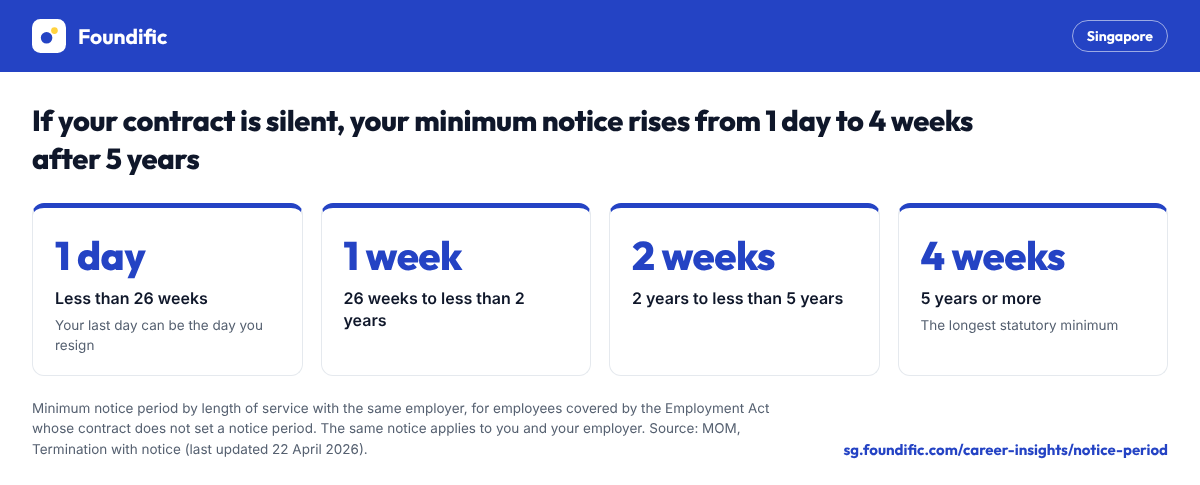
Minimum notice period by length of service
If your contract does not set a notice period, the minimum depends on how long you have worked for your employer. It ranges from 1 day to 4 weeks.
| Length of service | Minimum notice |
|---|---|
| Less than 26 weeks | 1 day |
| 26 weeks to less than 2 years | 1 week |
| 2 years to less than 5 years | 2 weeks |
| 5 years or more | 4 weeks |
Notice must be in writing, such as a letter or email. Ask your employer to acknowledge it, so there is no dispute later about when your notice started.
Our resignation letter guide has templates you can adapt, and Foundific's resignation letter template fills in your details and works out your last day.
Contract notice vs statutory notice
The notice period in your contract is the one you follow. The statutory table above applies only when the contract is silent.
Whatever the length, it must be the same for you and your employer. A contract that asks you for three months but lets your employer give you one week does not meet this rule.
If you are on a fixed-term contract, you can still resign at any time, as long as you serve the notice or pay salary in lieu. You and your employer can also agree to waive notice, and the agreement should be in writing.
When a job application asks for your notice period, it usually wants to know how soon you could start. A clear answer is the period in your current contract, minus any leave offset your employer has already agreed to.
Salary in lieu of notice: how to calculate it
Salary in lieu of notice is how you "buy out" your notice. It equals the gross salary for the part of the notice period you do not serve, and whoever ends the contract early pays it.
Gross salary includes most fixed allowances but leaves out overtime, bonuses, the annual wage supplement (AWS), and travel, food and housing allowances. Central Provident Fund (CPF) contributions are not required on salary in lieu of notice.
For notice set in days or weeks, use the daily gross rate:
Daily gross rate = 12 x monthly gross pay / (52 x days you work a week)
Worked example 1: buying out one month
Your gross pay is S$5,000 a month and your contract has one month's notice. You want to leave the day you resign.
- Salary in lieu of one month's notice = one month's gross pay = S$5,000, paid by you to your employer
Worked example 2: buying out two weeks
Same salary, 5-day week, but your notice is two weeks.
- Daily gross rate: 12 x S$5,000 / 260 = S$60,000 / 260 = S$230.77
- Two weeks is 10 working days: 10 x S$230.77 = S$2,307.69
If you serve part of the notice, you pay only for the days you do not serve. If your employer deducts the amount from your final salary, agree the figure in writing first.
If your employer asks you to leave early
If you have resigned and your employer tells you to leave before your notice ends, your employer must pay you salary in lieu for the rest of the notice period.
Your final salary is due on your last day or within 3 working days after it.
Using leave to offset your notice period
You can use annual leave to bring your last day forward, but only if your employer agrees. Sick, unpaid, reservist and maternity leave each work differently.
| Leave during notice | Effect on your notice |
|---|---|
| Annual leave used to offset notice | Allowed with your employer's agreement; your last day moves earlier and you are paid up to that day |
| Annual leave taken during notice | Needs your employer's approval; the notice period does not change |
| Sick leave | Counts as part of your notice period |
| Unpaid leave | Notice stays the same unless you both agree to extend it |
| Reservist training | Does not count as notice; your notice period is extended |
| Maternity leave | Cannot shorten your notice, but leave taken during notice counts towards it |
Check your annual leave balance before you resign, including any days carried forward. The annual leave calculator pro-rates this year's entitlement for you. If you are expecting a child, note that any maternity leave you have not used is forfeited once you leave your job.
Our maternity leave guide explains how maternity leave works during your notice period.
Termination without notice: when it's allowed
You or your employer can end the contract without notice if the other side has breached its terms. The side that breached it pays salary in lieu of notice.
| Situation | Who can end it without notice |
|---|---|
| Your salary is not paid within 7 days of being due | You, after first checking with your employer why it has not been paid |
| You are absent for more than 2 working days in a row without approval or a good excuse | Your employer |
| An inquiry finds misconduct | Your employer, with no salary in lieu of notice |
| Either side wants to leave early | Either side, by paying salary in lieu of notice |
During a misconduct inquiry, your employer can suspend you for up to 1 week without the Commissioner for Labour's approval, and must pay at least half your salary.
Some contracts add a separate payment for leaving early. Those terms fall outside the Employment Act and are settled in the civil courts.
Last-day calculator walkthrough
Your last day is the date your notice period ends, counting the day you give notice as day one. Work it out in four steps.
- Find your notice period. Use your contract, or the statutory table if the contract is silent.
- Mark day one. The day you hand in written notice is the first day of your notice period. With 1 day's notice, your last day is the same day.
- Count forward. Add the full notice period from day one.
- Subtract any agreed leave offset. Each day of annual leave your employer agrees to offset moves your last working day one working day earlier.
Worked example
You resign by email on Monday 2 November 2026, with one month's notice in your contract. Counting 2 November as day one, your notice ends on Tuesday 1 December 2026.
Your employer agrees that you can offset 5 days of annual leave. The five working days before and including 1 December are 25, 26, 27 and 30 November and 1 December, so your new last day is Tuesday 24 November 2026.
You are paid up to that day.
Check the public holidays calendar if your notice spans a holiday, because a holiday changes which working days your leave offset covers.
What to do if your employer doesn't comply
If your employer does not pay salary in lieu, holds back your final salary or refuses to accept your notice, raise it in writing first. If that fails, file a claim with the Tripartite Alliance for Dispute Management (TADM).
| Claim | Deadline |
|---|---|
| Salary claim, still employed | Within 1 year after the dispute arose |
| Salary claim, no longer employed | Within 6 months from your last day of work |
| Wrongful dismissal | Within 1 month from your last day |
Claims are capped at S$20,000, or S$30,000 through a union or the Tripartite Mediation Framework. Employers can also file claims at TADM for salary in lieu of notice that you owe them.
If you are a manager or executive dismissed with notice or salary in lieu, you can file a wrongful dismissal claim only after at least 6 months of service.
Work it out with Foundific's notice period calculator
Foundific's notice period calculator gives you your last working day from the date you give notice and your contract's notice period, or the statutory minimum if your contract is silent.
Add your monthly pay for a salary in lieu estimate, and any agreed leave offset to see an earlier last day.
Frequently asked questions
What is a notice period?
A notice period is the time between giving written notice that your employment will end and your last day of work. It applies to resignations and to terminations by your employer, and the length must be the same for both sides. Your contract sets it; if the contract says nothing, the minimum is 1 day to 4 weeks depending on your length of service.
What is the minimum notice period in Singapore?
If your contract does not set one, the minimum notice is 1 day for under 26 weeks of service, 1 week for 26 weeks to under 2 years, 2 weeks for 2 to under 5 years, and 4 weeks for 5 years or more. If your contract sets a longer period, such as one month, you follow the contract.
How is salary in lieu of notice calculated?
Salary in lieu of notice equals your gross salary for the notice you do not serve, so one month's notice costs one month's gross pay. For days or weeks, multiply your daily gross rate, 12 x monthly gross pay / (52 x days worked a week), by the working days left. On S$5,000 a month and a 5-day week, two weeks is S$2,307.69.
Can I use annual leave to offset my notice period?
Yes, but only if your employer agrees. Offsetting means your annual leave covers the last days of your notice, so your last working day comes earlier and you are paid up to that new date. Without agreement, you serve the full notice. Taking annual leave during your notice period also needs your employer's approval.
What does tender resignation mean?
To tender your resignation means to formally give your employer written notice that you are leaving, usually by letter or email. Your notice period starts on the day you tender it, and that day counts as the first day of notice.
Is CPF payable on salary in lieu of notice?
No. CPF contributions are not required on salary in lieu of notice. This applies when you pay it to your employer to leave early and when your employer pays it to you for releasing you early. Your final salary, including any notice pay owed to you, is due on your last day or within 3 working days after it.
Related guides
This guide summarises the rules for employees covered by Singapore's Employment Act as of 27 October 2026. Your contract may give you more. For your specific situation, check with MOM, CPF Board or IRAS.