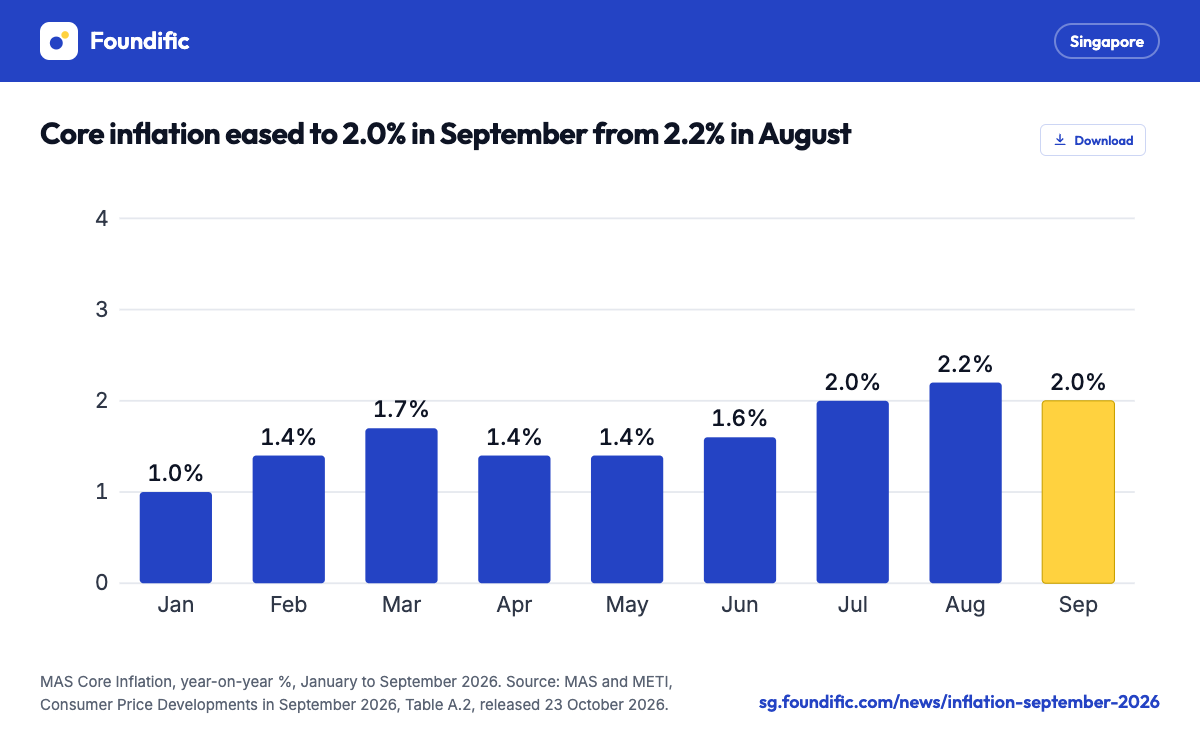
Singapore's MAS Core Inflation eased to 2.0% year on year in September 2026, from 2.2% in August. The Monetary Authority of Singapore (MAS) and the Ministry of Energy, Trade and Industry (METI) published the figures on 23 October.
- Services and retail and other goods slowed, which pulled core inflation down.
- Overall prices (CPI-All Items) rose 2.2%, down from 2.3%.
- Electricity and gas stayed at 8.7%, after the regulated electricity tariff rose in the third quarter.
What this means for you
- Prices were 2.2% higher than in September 2025. A pay rise below that rate buys less than your pay did a year ago. The table below shows what 2%, 3% and 5% are worth.
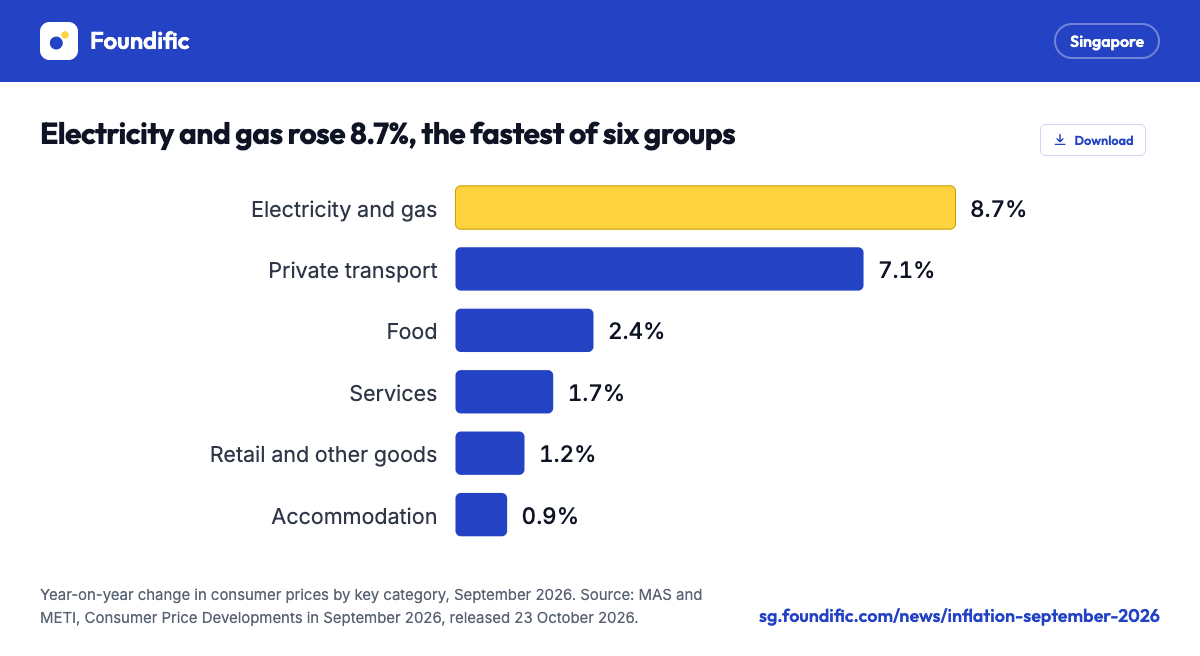
- Electricity and gas cost 8.7% more than a year earlier, the fastest rise of the main groups.
- See what a rise adds after CPF and tax with the take-home pay calculator.
- MAS and METI forecast core inflation of 1.5% to 2.5% in 2027. Rises set for 2027 can be compared with that range.
- A rise below 2.2% leaves staff able to buy less than a year earlier. Check pay against the market with the salary comparison.
Key categories
| Category | Weight (of 10,000) | August 2026 | September 2026 |
|---|---|---|---|
| Food | 2,042 | 2.3% | 2.4% |
| Services | 3,173 | 2.0% | 1.7% |
| Retail and other goods | 1,025 | 1.8% | 1.2% |
| Electricity and gas | 198 | 8.7% | 8.7% |
| Private transport | 906 | 7.5% | 7.1% |
| Accommodation | 2,656 | 0.8% | 0.9% |
Private transport and accommodation are left out of MAS Core Inflation. Weight is the category's share of the CPI basket.
What changed in September
MAS and METI gave these reasons for each move:
- Services slowed because point-to-point transport costs rose less and telecommunication prices fell further.
- Retail and other goods slowed as furniture prices fell and clothing prices rose more slowly.
- Private transport slowed because car prices rose more gradually.
- Food rose faster, with higher inflation for both non-cooked food and food services.
- Accommodation edged up as housing rents rose faster.
On the month, core prices rose 0.1% and overall prices 0.2%.
Why electricity stays high
Electricity and gas inflation has been 8.7% since July. The regulated electricity tariff for each quarter is set largely from natural gas prices in the first two and a half months of the quarter before.
The tariff rise in the third quarter of 2026 followed the spike in global energy prices from April to mid-June, MAS and METI said.
Your numbers
| Monthly pay | Pay rise | Extra a month | Real rise after 2.2% inflation |
|---|---|---|---|
| S$3,000 | 2% | S$60 | −0.2% |
| S$3,000 | 3% | S$90 | 0.8% |
| S$5,000 | 3% | S$150 | 0.8% |
| S$5,000 | 5% | S$250 | 2.7% |
Foundific calculations: real rise = (1 + pay rise) ÷ 1.022 − 1, before CPF contributions and tax. The 2.2% compares September 2026 with September 2025.
The outlook
MAS and METI expect core inflation to stay slightly elevated in the next few quarters, then ease more clearly from mid-2027.
- MAS Core Inflation: 1.5% to 2.0% in 2026, and 1.5% to 2.5% in 2027.
- CPI-All Items: around 2.0% in 2026, and 1.5% to 2.5% in 2027.
- MAS and METI said the risks are tilted to the upside, including a sharp and sustained surge in global energy or food prices.
What to do next
- See how the median income has moved before and after inflation in wage growth in Singapore.
- Ask for a pay rise with the salary increment letter.
- Work out a rise after CPF and tax with the take-home pay calculator.
- The release does not give the date of the next report. MAS lists each report on its consumer price developments page.
Related guides
Sources
MAS and METI, Consumer Price Developments in September 2026
- MAS and METI, Consumer Price Developments in September 2026 Released 23 October 2026. PDF copy kept in data/sg/mas/raw.