The Ministry of Manpower (MOM) measures labour force participation once a year, in June. The latest figures are for June 2025 and were published in Labour Force in Singapore 2025 on 29 January 2026.
Labour force participation at a glance
| Residents, June | 2023 | 2024 | 2025 |
|---|---|---|---|
| Labour force participation rate, aged 15 and over | 68.6% | 68.2% | 67.9% |
| Employment rate, aged 25 to 64 | 82.6% | 83.4% | 83.3% |
| Employment rate, aged 15 and over | 66.2% | 66.0% | 65.7% |
| Resident labour force | 2,436,200 | 2,446,400 | 2,456,400 |
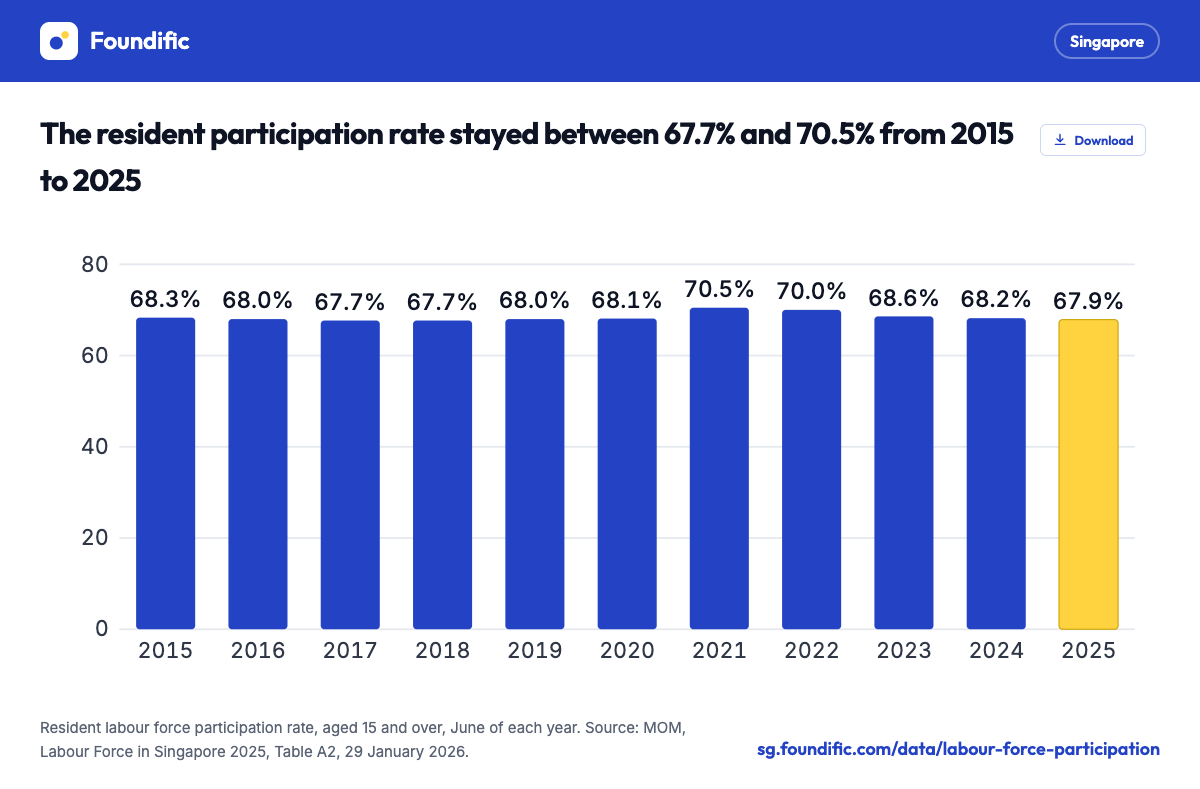
- 67.9% participation rate for residents aged 15 and over in June 2025, down from 68.2% in 2024.
- Fourth fall in a row from 70.5% in 2021, which MOM links to population ageing.
- 2,456,400 residents in the labour force, 10,000 more than in June 2024.
- 83.3% of residents aged 25 to 64 employed, against 83.4% in 2024 and 80.5% in 2015.
- 80.5% of women aged 25 to 64 in the labour force, up from 74.1% in 2015.
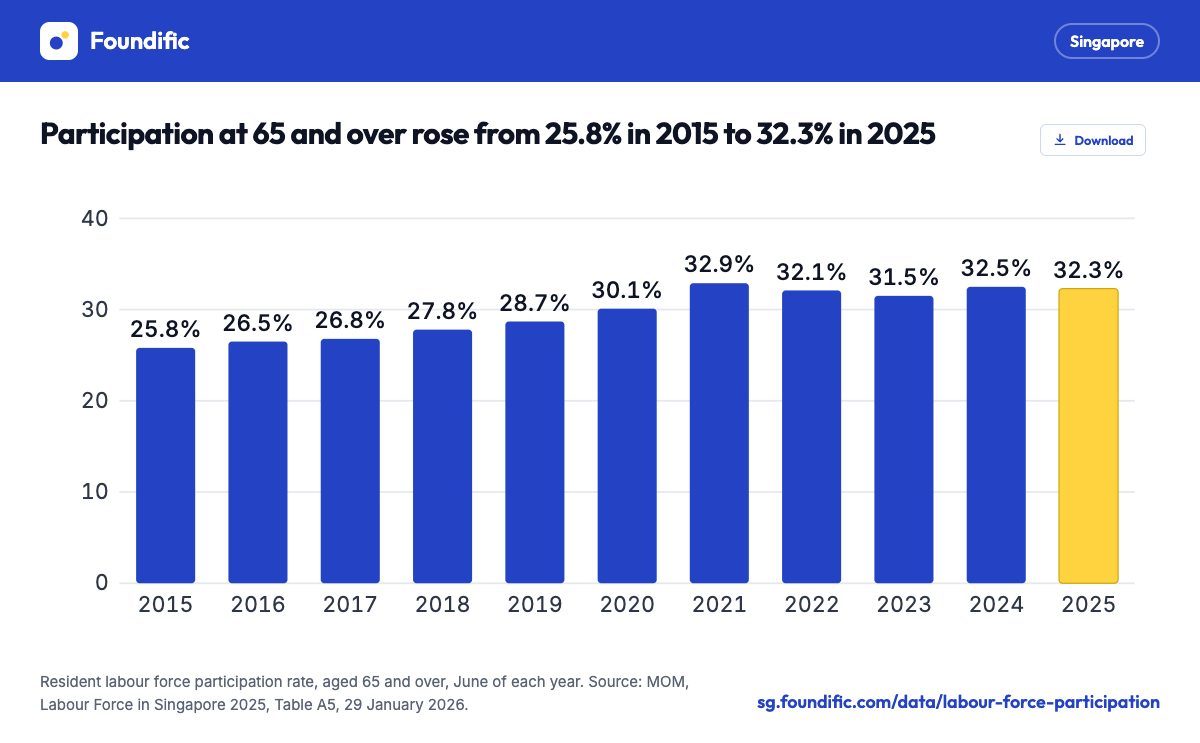
- 32.3% of residents aged 65 and over in the labour force, up from 25.8% in 2015.
What is the labour force participation rate in Singapore?
67.9% of residents aged 15 and over were working or looking for work in June 2025. The rate was 2.6 percentage points below its 2021 level of 70.5%.
The participation rate is the share of residents aged 15 and over who are employed or unemployed. Residents are Singapore citizens and permanent residents.
- In June 2025, 2,376,400 residents were employed and 80,000 were unemployed.
- 1,162,800 residents were outside the labour force.
- The total labour force, including non-residents, was 4,068,600. Non-residents made up 1,612,200 of it.
MOM puts the 95% confidence interval for the 2025 rate at 67.5% to 68.3%.
Labour force participation since 2015
The rate rose to 70.5% in 2021, the highest in MOM's series since 1991, and has fallen each year since.
- MOM attributes the fall to an older population. MOM, citing SingStat, puts the share of residents aged 15 and over who were 55 or older at 37.9% in 2025, against 30.2% in 2015.
- If the age profile had stayed the same, MOM estimates the 2025 rate would have held at the 2024 level.
- On that basis the rate would be 2.2 percentage points higher than in 2015.
- By 2029, all post-war baby boomers (born 1946 to 1964) will be 65 or older.
The resident labour force grew by 224,100 from 2015 to 2025. The median age of the labour force was 45 in 2025, against 43 in 2015.
Participation by sex
Participation among women aged 25 to 64 rose by 6.4 percentage points from 2015 to 2025. For men of the same age it stayed above 91%.
| Participation rate | 2015 | 2024 | 2025 |
|---|---|---|---|
| Men, aged 15 and over | 76.7% | 74.0% | 73.6% |
| Women, aged 15 and over | 60.4% | 62.8% | 62.5% |
| Men, aged 25 to 64 | 92.7% | 91.8% | 91.8% |
| Women, aged 25 to 64 | 74.1% | 80.7% | 80.5% |
- Women made up 47.7% of the resident labour force in 2025, up from 45.5% in 2015.
- 49.9% of women aged 15 and over held a degree, diploma or professional qualification in 2025, against 38.9% in 2015.
- The rate for men aged 15 and over, 73.6%, was the lowest in MOM's series since 1991.
MOM compares women aged 25 to 64 with OECD countries.
- Singapore ranked 18th, below the 85.8% average of the top six OECD countries in 2024.
- Their part-time employment rate was 5.9%, against an OECD average of 13.7%.
- 61.5% of those outside the labour force gave family responsibilities as the reason.
Participation by age group
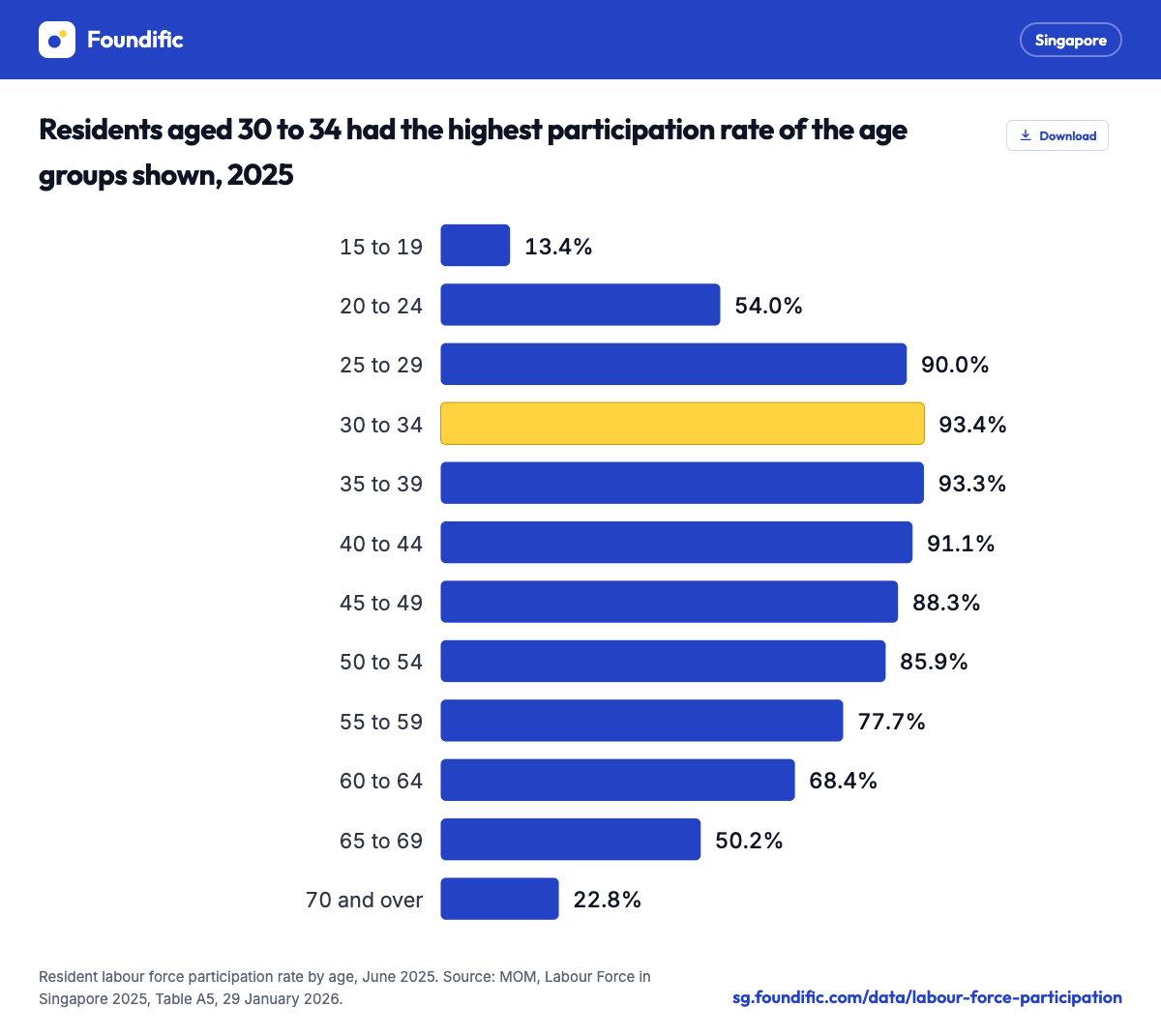
From 2015 to 2025 the rate rose in every five-year age group from 30 upwards.
- At 60 to 64 it rose from 62.4% to 68.4%, the highest in MOM's series since 1991.
- At 55 to 64 it reached 73.1%, also the highest since 1991.
- At 20 to 24 it fell by 11.3 percentage points, to 54.0%.
- 42.8% of residents aged 20 to 24 were studying or training outside the labour force in 2025, against 31.5% in 2015.
The rate for ages 15 to 24 was 33.7% in 2024 and 2025, the lowest in the series since 1991.
Employment rate by age
The employment rate is the share of the population in work. It leaves out the unemployed, who count in the participation rate.
| Employment rate | 2015 | 2024 | 2025 |
|---|---|---|---|
| Aged 15 to 24 | 36.8% | 31.2% | 31.3% |
| Aged 25 to 54 | 84.7% | 87.7% | 87.5% |
| Aged 55 to 64 | 67.2% | 70.4% | 70.8% |
| Aged 65 and over | 24.7% | 31.7% | 31.5% |
| Aged 25 to 64, women | 71.8% | 78.3% | 78.0% |
| Aged 25 to 64, men | 89.8% | 88.8% | 88.9% |
- MOM linked the small fall at 25 to 54 to slower hiring in information and communications, professional services, wholesale trade, finance and manufacturing.
- MOM's tables do not give an employment rate for ages 15 to 64.
- From Table A4, 2,116,200 of the 2,794,000 residents aged 15 to 64 were employed in June 2025, or 75.7% (Foundific calculation).
- On the same basis, the participation rate at 15 to 64 was 78.4%.
Older workers
266,500 residents aged 65 and over were in the labour force in June 2025, against 120,300 in 2015. Their participation rate rose by 6.5 percentage points over the decade.
- At 65 to 69 the rate was 50.2% in 2025: 60.2% for men and 41.0% for women.
- At 70 and over it was 22.8%.
- Residents aged 60 and over made up 19.3% of the labour force in 2025, up from 12.3% in 2015.
- The employment rate at 65 to 69 was 49.1%.
MOM names schemes including the Senior Employment Credit and Career Conversion Programmes.
- The Senior Employment Credit gives employers up to 7% in wage offsets for Singaporeans aged 60 and over earning below S$4,000 a month.
- Career Conversion Programmes give eligible older workers up to 90% salary and course fee support.
The resident old-age support ratio, residents aged 20 to 64 for each resident aged 65 and over, fell from 5.7 in 2015 to 3.3 in 2025.
Residents outside the labour force
There were 1.16 million residents outside the labour force in 2025, up from 1.14 million in 2024.
- 30.1% gave retirement as the main reason, up from 28.7% in 2024.
- 22.0% gave housework or caregiving.
- 72,500 were outside mainly for caregiving, down from 133,500 in 2019.
- 101,300 intended to look for work within two years, down from 118,500 in 2024.
- 7,400 were discouraged workers, not looking for work because they expected the search to fail.
What the figures mean for job seekers
The June 2025 survey shows most working-age residents in work.
- The resident unemployment rate was 3.3% in June 2025, not seasonally adjusted.
- 87.5% of residents aged 25 to 54 were employed.
- 70.8% of residents aged 55 to 64 were employed, up from 67.2% in 2015.
Monthly unemployment figures are on the unemployment rate page. Pay trends are on the wage growth page. To check an offer against MOM's median pay for your job and age, use the salary comparison.
How MOM measures labour force participation
- The figures come from the Comprehensive Labour Force Survey, run each year with June as the reference month. The 2025 report was the 48th edition.
- The survey covers private households. It excludes workers living in dormitories, construction worksites and workers' quarters.
- Fieldwork ran from 3 March 2025 to 31 July 2025.
- 33,000 dwelling units were sampled. 27,324 households responded, a response rate of 86.8%.
- The labour force is everyone aged 15 and over who is employed or unemployed.
- Employed means working at least one hour for pay or profit in the reference period, or having a job to return to.
- Unemployed means not working, actively looking for work and available for it.
- The figures are not seasonally adjusted.
- MOM's quarterly Labour Market Report does not carry the participation rate. MOM writes quarters as "Q2 2026"; this page writes "Q2 2026".
Release calendar
MOM publishes the June figures in two steps.
- The Labour Force in Singapore Advance Release 2026 is scheduled for 26 November to 2 December 2026 and will carry June 2026 figures.
- The full Labour Force in Singapore 2026 report is scheduled for 25 to 29 January 2027.
- The 2025 advance release was published on 28 November 2025 and the full report on 29 January 2026.
Questions
What is the labour force participation rate in Singapore?
The resident labour force participation rate was 67.9% in June 2025, according to MOM. It is the share of citizens and permanent residents aged 15 and over who are working or looking for work. It was 68.2% in 2024.
Why is Singapore's participation rate falling?
MOM links the fall to population ageing. Citing SingStat, it puts residents aged 55 or older at 37.9% of those aged 15 and over in 2025, against 30.2% in 2015. Without that shift, MOM estimates the 2025 rate would have stayed at the 2024 level.
How many older residents work in Singapore?
In June 2025, 32.3% of residents aged 65 and over were in the labour force, and 31.5% were employed. At 65 to 69 the participation rate was 50.2%.
What is the difference between the participation rate and the employment rate?
The participation rate counts the employed and the unemployed as a share of the population. The employment rate counts only the employed. For residents aged 25 to 64 the employment rate was 83.3% in June 2025.
When are the next labour force figures released?
MOM's Labour Force in Singapore Advance Release 2026, with June 2026 figures, is scheduled for 26 November to 2 December 2026.
Related guides
Sources
MOM Labour Force in Singapore 2025 (report and tables A1 to A7, B1), time series mrsd_1, mrsd_29 and mrsd_30, and the Labour Market Report Q2 2026 release calendar
- MOM, Labour Force in Singapore 2025 Released 29 January 2026. Chapter 2 (participation and employment rates), chapter 8 (residents outside the labour force), sampling errors and survey method.
- MOM, Labour Force in Singapore 2025, statistical tables, Sections A and B Released 29 January 2026. Tables A1, A2, A4, A5 and A7 (labour force and participation rate by age and sex) and B1 (employment rate by age and sex).
- MOM, Statistical Table: Labour Force (mrsd_1 and mrsd_29) Updated with June 2025 data. Resident labour force and participation rate by age and sex, 1991 to 2025.
- MOM, Statistical Table: Employment (mrsd_30) Released 29 January 2026. Resident employment rate by age and sex, 1991 to 2025.
- MOM, Labour Market Report, Second Quarter 2026 Released 21 September 2026. Release calendar, page A29.