Singapore's National Wages Council (NWC) has recommended a built-in wage increase of 6.0% to 8.0% for lower-wage workers, for the year from 1 December 2026 to 30 November 2027. The Government accepted the guidelines on 19 October.
6.0–8.0%Built-in wage increaseLower-wage workers, 2026/2027
S$2,800Monthly wage thresholdAbout the 20th percentile in 2025
S$135–S$170Minimum increaseFirms that have done well
Source: MOM, NWC 2026/2027 Guidelines, released 19 October 2026.
In short
- The guidelines cover employees earning up to S$2,800 a month in gross wages.
- The range and the minimum dollar increases are both higher than last year's, the NWC says.
- A new category covers firms that have not done well and are unprofitable.
What this means for you
If you are an employee
- Earning S$2,800 or less a month? The guidelines recommend a rise from 1 December 2026 of at least S$120, or S$135 to S$170 if your employer has done well.
- Gross wage here includes allowances, overtime and your own CPF, but not bonuses or the Annual Wage Supplement. See where your pay sits with the salary comparison.
- Above S$2,800 there is no set figure: firms that have done well are asked to give built-in rises and bonuses in line with performance.
If you are an employer
- For staff at S$2,800 or less, budget for 6.0% to 8.0%, or the dollar minimum where it is higher.
- The Progressive Wage Credit Scheme co-funds 30% of qualifying rises in 2026 and 2027. From 2027 the average rise must be at least S$200 a month to qualify.
- Employer CPF for staff aged above 55 to 65 rises by 0.5 percentage point on 1 January 2027, with a CPF Transition Offset for that year.
Download
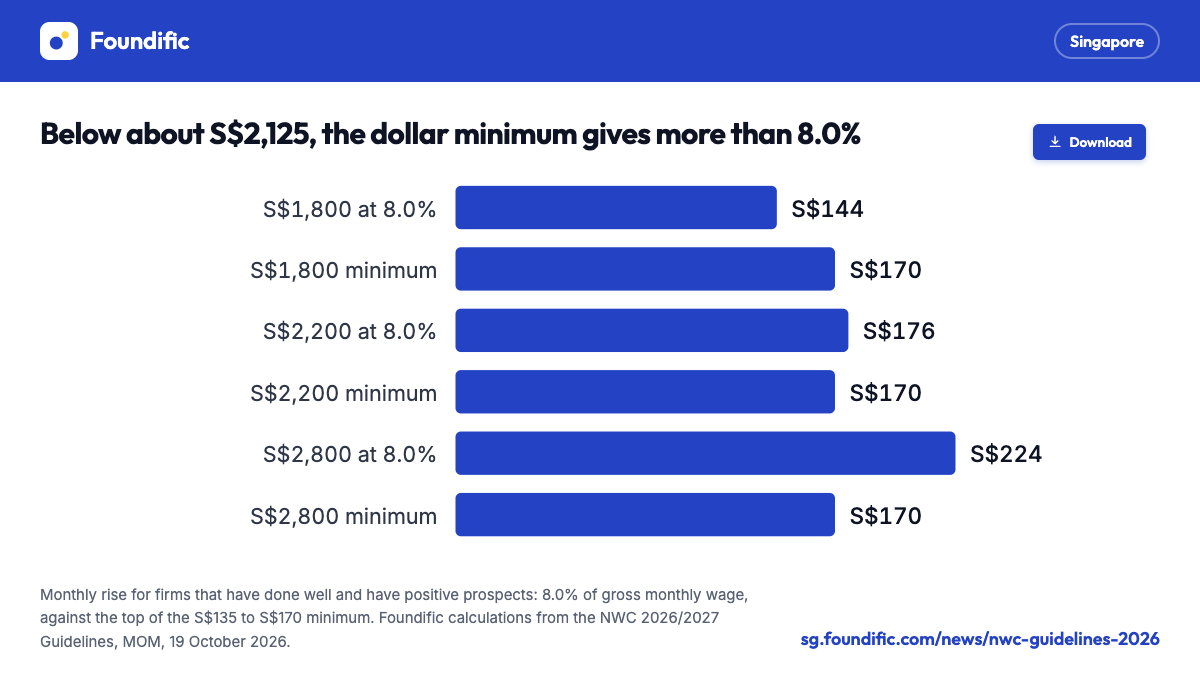
Below about S$2,125, the dollar minimum gives more than 8.0%
What each employer should give
| Employer | Recommended increase |
|---|---|
| Done well, positive prospects | Higher end of 6.0% to 8.0%, or at least S$135 to S$170 |
| Done well, uncertain prospects | Around the middle of 6.0% to 8.0%, or at least S$135 to S$170 |
| Not done well, still profitable | Lower end of 6.0% to 8.0%, or at least S$120 |
| Not done well, unprofitable | At least S$120 |
The higher of the percentage and the dollar amount applies. The threshold of S$2,800 is about the 20th percentile wage of full-time employed residents in 2025; the median was S$5,775.
Your numbers
| Gross monthly wage | 6.0% | 8.0% | Minimum, firms that did well | Minimum, other profitable firms |
|---|---|---|---|---|
| S$1,800 | S$108 | S$144 | S$135 to S$170 | S$120 |
| S$2,200 | S$132 | S$176 | S$135 to S$170 | S$120 |
| S$2,800 | S$168 | S$224 | S$135 to S$170 | S$120 |
Foundific calculations. Below S$2,000 a month, 6.0% is less than S$120, so the dollar minimum decides the rise at firms that did not do well. Below about S$2,125, even 8.0% is less than S$170.
The figures behind it
- Economy: GDP grew 6.0% in the first three quarters of 2026.
- Productivity: real value-added per hour worked rose 3.8% in the first half of 2026.
- Real income: mean real gross monthly income grew 2.1% in the first half, and 1.3% a year from 2016 to 2025.
- Pay plans: firms planning to raise wages rose from 23.7% in May 2026 to 29.3% in June.
- Training: employees receiving structured training fell from 52.6% in 2024 to 48.1% in 2025.
What to do next
- Employees: check your pay against your job with the salary comparison, and ask for a review with the salary increment letter.
- After CPF: see what a rise leaves with the take-home pay calculator.
- Trends: read wage growth in Singapore.
- When: the guidelines apply from 1 December 2026 to 30 November 2027.
Related guides
Sources
MOM, National Wages Council 2026/2027 Guidelines
- MOM, NWC Guidelines for 2026/2027 (press release) Released 19 October 2026.
- NWC 2026/2027 Guidelines (PDF) Table 1 and paragraphs 16 to 18. Copy kept in data/sg/mom/nwc/raw.