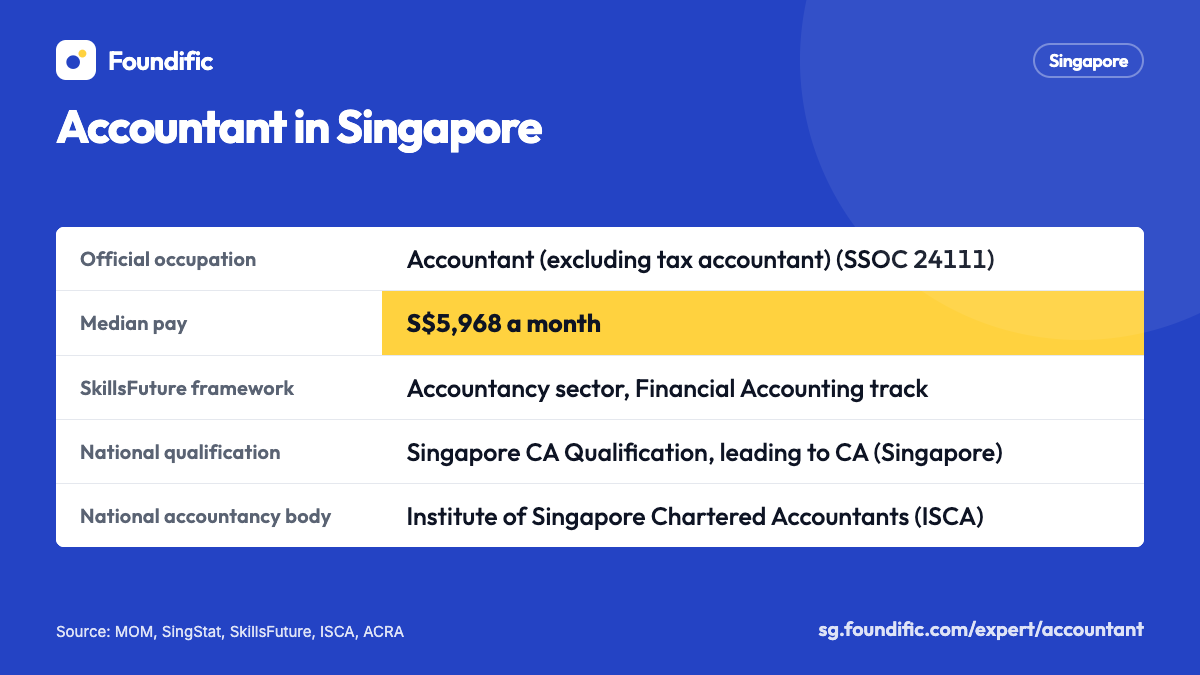
Accountant in Singapore
- Official occupation: Accountant (excluding tax accountant) (SSOC 24111) SingStat
- SkillsFuture framework: Accountancy sector, Financial Accounting track SkillsFuture
- National qualification: Singapore CA Qualification, leading to CA (Singapore) ISCA
- National accountancy body: Institute of Singapore Chartered Accountants (ISCA) ISCA
- Accounting standards: SFRS(I), FRS and SFRS for Small Entities ACRA
What does an accountant do?
An accountant records, checks and reports an organisation's financial transactions.
The job covers the general ledger, month-end close, financial statements, GST and corporate tax work. Many accountants also oversee a small team of accounts executives.
In a Singapore company, the accountant sits in the finance team and usually reports to a finance manager or financial controller. Smaller firms may have one accountant who handles everything from payables to tax filing.
You work with the finance manager, accounts executives, external auditors and tax agents. You also deal with department heads who need figures, and with suppliers and customers on payment queries.
What the work involves
- Post and review journal entries, accruals and allocations in the accounting system.
- Run the month-end close: reconcile accounts, check balances and produce management accounts.
- Prepare financial statements and disclosure notes under Singapore reporting standards.
- Compute GST returns and support corporate tax filings in line with Inland Revenue Authority of Singapore (IRAS) requirements.
- Answer auditor queries, explain variances and fix issues found in audits.
- Manage payables and receivables data, and help with budgets and forecasts.
What you might build in your first months
These are our examples of work a new accountant might be given in the first months.
Every employer is different.
| Example | What it involves | Source |
|---|---|---|
| Take over the bank reconciliations | Reconcile the company's bank accounts each month, clear old unmatched items and write down how each one was resolved. | |
| Prepare one month-end close | Post accruals, prepayments and depreciation, check the trial balance and produce the month's management accounts for review. | |
| Prepare a GST return draft | Pull the quarter's sales and purchase data, check the tax codes and prepare a draft return for your manager to review before filing. |
Pay in Singapore
The median is S$5,968 a month, gross.
MOM, Occupational Wages 2025, Table 4 (all industries), June 2025. Full-time resident employees; gross monthly wage, excluding bonuses. Full pay data
Skills an accountant needs
Core skills
Reporting, the month-end close, GST and corporate tax are the work an accountant signs off and answers for.
- Financial reporting (SFRS)
- IFRS & SFRS(I)
- Month-end close
- GST (IRAS)
- Corporate tax (IRAS)
Tools and platforms
Accounting software, ERP finance modules and Excel are where you post entries, reconcile accounts and build reports each day.
- Accounting software (Xero, QuickBooks)
- Excel
- ERP finance modules (SAP FICO, NetSuite)
AI
AI tools can draft explanations and summaries, and you still check every figure against the books and follow company data rules.
- ChatGPT
How to become an accountant in Singapore
These are the main routes into accounting in Singapore.
Check each official page for current intakes and entry rules.
| Route | What it involves | Source |
|---|---|---|
| University degree in accountancy | Nanyang Technological University (NTU) offers a Bachelor of Accountancy, a three-year direct honours degree. Other universities in Singapore also offer accountancy degrees. | NTU |
| Polytechnic diploma | Ngee Ann Polytechnic offers a Diploma in Accountancy (N51). Temasek Polytechnic offers a Diploma in Accountancy & Finance (T02). Both list exemptions from ISCA and ACCA courses or examinations. | Ngee Ann Polytechnic Temasek Polytechnic |
| Singapore CA Qualification | The national CA qualification has a Foundation Programme for candidates who need it, a Professional Programme and practical experience. It is open to accountancy and non-accountancy degree holders and to local polytechnic diploma holders. Completing it leads to the CA (Singapore) designation. | ISCA |
| Practical experience for the CA Qualification | Candidates work for an Accredited Training Organisation under a Training Agreement. They need a minimum of 3 full years and at least 450 working days of practical experience. | ISCA |
| ACCA pathway to CA (Singapore) | ACRA and ISCA announced an enhanced pathway on 26 March 2025, open until 25 March 2028. ACCA members with at least 10 years of membership and relevant experience can apply without taking the Singapore CA Qualification. | ACRA |
Accountant courses and funding in Singapore
These schemes help pay for accounting courses in Singapore.
Check the official pages for current rules before you sign up.
| Course or scheme | What it offers | Source |
|---|---|---|
| SkillsFuture Credit | All Singapore Citizens aged 25 and above can use SkillsFuture Credit for courses on the MySkillsFuture portal. Submit your claim online before the course start date. | MySkillsFuture |
| SkillsFuture Credit (Mid-Career) | Singapore Citizens aged 40 and above get a further credit for selected courses on MySkillsFuture, marked with a Mid-Career label. | MySkillsFuture |
| Course fee funding | Singapore Citizens and permanent residents get up to 70% of course fees for Tier 1 courses and up to 50% for Tier 2. Citizens aged 40 and above get up to 90% and 70%. | MySkillsFuture |
| Singapore CA Qualification | ISCA runs the Foundation Programme and the Professional Programme. Diploma holders from some polytechnic accountancy courses get module exemptions. | ISCA Ngee Ann Polytechnic Temasek Polytechnic |
| Finding courses | Search MySkillsFuture for terms such as financial reporting, GST or corporate tax. Each course listing shows the funding and credit it accepts. | MySkillsFuture |
Where the jobs are
Accountants work in companies across all sectors, in accounting firms and in public agencies.
These official facts relate to accounting work in Singapore.
- The SkillsFuture Skills Framework places the accountant role in the Accountancy sector, in the Financial Accounting track. SkillsFuture
- Non-listed companies file an annual return with ACRA within seven months after the financial year end. Listed companies file within five months. ACRA
- Companies file Estimated Chargeable Income with IRAS within 3 months from the end of the financial year, unless an exception applies. IRAS
- Independent statutory audits are carried out by public accountants registered with ACRA. ACRA
Rules and frameworks in Singapore
These are the main Singapore rules and standards that accounting work touches.
Check the regulator's own page for the current version.
| Rule or framework | What it covers | Source |
|---|---|---|
| Accountants Act and public accountant registration | Public accountants must register with ACRA to carry out independent statutory audits. They have legal obligations under the Accountants Act. Checked on 25 October 2026. | ACRA |
| Singapore accounting standards | The Accounting Standards Committee (ASC) under ACRA issues SFRS(I), FRS and the SFRS for Small Entities. Entities check the relevant Acts and Statement of Applicability for which set applies. Checked on 25 October 2026. | ACRA |
| SFRS for Small Entities, third edition | Issued by the ASC on 18 August 2025. It takes effect for annual reporting periods beginning on or after 1 January 2027. | ACRA |
| ACRA annual return | Non-listed companies file within seven months after the financial year end, and listed companies within five months. Companies with a share capital and an overseas branch register get one extra month. | ACRA |
| IRAS corporate income tax filing | Companies file Estimated Chargeable Income within 3 months from the financial year end, unless an exception applies. IRAS lists 30 November as the due date for Form C-S, Form C-S (Lite) and Form C. | IRAS IRAS |
| IRAS GST returns | GST-registered businesses file a return for each accounting period. IRAS lists each return as due one month after the period ends. | IRAS |
| ISCA and the CA (Singapore) designation | ISCA is the national accountancy body of Singapore. Candidates who complete the Singapore CA Qualification can apply for full ISCA membership and the CA (Singapore) designation. | ISCA ISCA |
Accountant job description
An accountant runs day-to-day accounting for an organisation's Singapore entity.
The role covers the ledger, the monthly close and financial statements. It often includes guiding a small team, supporting audits and keeping the company in line with accounting standards, GST and corporate tax rules.
Responsibilities
- Prepare monthly, quarterly and annual financial statements and management accounts.
- Lead the month-end close and keep a close checklist and timetable.
- Review journal entries, accruals, prepayments and fixed asset records.
- Reconcile bank, intercompany, payables and receivables accounts.
- Prepare GST returns and corporate tax computations, and work with tax agents.
- Support internal and external audits and respond to findings.
- Supervise accounts executives and review their work.
- Apply internal controls to reduce errors and fraud risk.
- Prepare consolidation schedules for group reporting if the company has subsidiaries.
- Help with budgets, forecasts and cash and working capital reports.
Requirements
- Degree or diploma in accountancy, accounting and finance, or a related field.
- Typically 2 to 5 years of accounting experience, often with an audit or corporate finance background.
- Working knowledge of SFRS(I) or FRS, and of Singapore GST and corporate tax rules.
- Hands-on use of accounting software such as Xero or QuickBooks, or an ERP such as SAP or NetSuite.
- Strong Excel skills, including lookups, pivot tables and reconciliations.
- Progress towards a professional qualification, such as Chartered Accountant of Singapore, is often preferred.
Accountant career path
Most accountants start as accounts executives and move up through accountant and finance manager roles towards financial controller.
Moving up usually needs wider reporting, tax and team-leading skills.
Accounts executive
Entry
You handle transactions, reconciliations and filing, working under an accountant or finance manager.
Accountant / senior accounts executive
Mid · SkillsFuture title
You run the ledger and month-end close, prepare financial statements and lead a small team.
Finance manager
Senior
You manage the whole finance team, own reporting and audit results, and advise management on budgets and controls.
Financial controller
Lead
You own accounting, reporting, tax and controls for the organisation and report to the finance head or the board.
Steps marked "SkillsFuture title" follow the career pathway in the SkillsFuture Skills Framework. The others are titles commonly used in Singapore.
Related jobs and their pay
| Related job | Median pay a month | Why it is related |
|---|---|---|
| Financial analyst (FP&A) | S$8,366 | Your close and reporting experience carries over to budgeting, forecasting and business partnering. |
| Auditor | S$5,750 | Knowing the ledger and the standards helps you test other organisations' accounts and controls. |
| Investment analyst | S$8,050 | Skills in reading financial statements and valuing assets apply directly to company and investment analysis. |
MOM Occupational Wages 2025, gross monthly wage, full-time resident employees. Each figure links to its salary guide.
Accountant interview questions
We wrote these questions from the skills this job needs. They are not an official question bank.
Walk me through the steps of your month-end close.
What a good answer covers
- Cut-off checks and posting of accruals, prepayments and depreciation
- Bank, payables, receivables and intercompany reconciliations
- Review of the trial balance and unusual movements
- Sign-off timeline and checklist, with owners for each step
- Ways you have shortened the close
How does SFRS(I) relate to IFRS, and when might a Singapore company use the simpler framework for small entities?
What a good answer covers
- SFRS(I) is Singapore's version of IFRS and is aligned with it
- Which framework applies is set by the relevant Act and the ASC Statement of Applicability
- A simplified framework exists for eligible small entities
- Eligibility depends on size and company type, so check the current rules
- The choice affects disclosures and measurement
Your company pays annual insurance in advance in March. What entries do you post, and how does the balance change by December?
What a good answer covers
- Debit prepayment and credit cash at payment
- Monthly release from the prepayment to insurance expense
- Balance sheet shows the unused portion at year-end
- Mention of accrual basis and matching
- Checks that the schedule agrees with the ledger
How do you reconcile intercompany balances before consolidating group accounts?
What a good answer covers
- Agree balances and currencies with each entity
- Match invoices and cut-off differences
- Investigate unmatched items and correct them in the right entity
- Eliminate intercompany balances and profit on consolidation
- Keep a schedule for the auditors
How do you decide whether GST on a supplier invoice can be claimed as input tax?
What a good answer covers
- Check for a valid tax invoice in the company's name
- Confirm the purchase is for making taxable supplies
- Know that some expense types are blocked from claims
- Use the correct tax code in the system
- Check current IRAS guidance when unsure
How do you get from accounting profit to chargeable income for corporate tax?
What a good answer covers
- Add back non-deductible expenses and book depreciation
- Deduct capital allowances in place of depreciation
- Remove non-taxable income
- Apply losses and allowances brought forward where allowed
- Document the computation for the tax agent and IRAS
You receive a 20,000-line ledger export. How do you use Excel to find duplicates and mismatches against the bank statement?
What a good answer covers
- Clean the data and standardise dates and references
- Use lookup functions to match ledger lines to bank lines
- Flag duplicates with COUNTIF or conditional formatting
- Use a pivot table to summarise differences
- Keep the original data untouched and document the steps
In SAP FICO or NetSuite, how would you trace a trial balance figure back to the source transactions?
What a good answer covers
- Drill down from the account balance to line items
- Check document numbers, posting dates and users
- Compare with sub-ledgers such as payables or receivables
- Check manual journals for support
- Note any report you built to repeat this check
On day three of the close, the trial balance is out of balance. What do you do?
What a good answer covers
- Find the size of the difference and when it first appeared
- Check recent journals, imports and interfaces
- Test for transposition errors or half-posted entries
- Fix the entry with a documented correction
- Tell your manager if the close deadline is at risk
The external auditor questions a large revenue variance against last year. How do you respond?
What a good answer covers
- Pull the data behind the variance before replying
- Split it into price, volume and one-off items
- Give contracts and invoices as support
- Admit errors found and propose a fix
- Record the response and any control change
A colleague wants to paste a vendor ledger into ChatGPT to draft an explanation of variances. What do you advise?
What a good answer covers
- Check the company's AI and data policy first
- Remove names, bank details and other confidential data
- Use summarised figures or fictitious samples
- Verify any AI output against the books
- Keep accountability with the accountant
Tell me about a time you had to deliver accounts under a tight deadline.
What a good answer covers
- A specific situation and the deadline
- How you ranked tasks and shared work
- How you kept accuracy while moving fast
- Result and what you changed afterwards
A senior manager asks you to book revenue earlier to hit a target. What do you do?
What a good answer covers
- Explain the revenue recognition rule that applies
- Refuse to post an entry you cannot support
- Offer a legitimate alternative, such as better forecasting
- Escalate to the finance head or audit committee if pressed
- Show awareness of professional ethics
You find a GST error in a return already filed with IRAS. What steps do you take?
What a good answer covers
- Work out the size and cause of the error
- Tell your manager or tax agent promptly
- Check IRAS guidance on correcting returns and voluntary disclosure
- Fix the process or control that caused it
- Keep a record of the correction
How do you handle employee and vendor personal data in accounting files under the Personal Data Protection Act (PDPA)?
What a good answer covers
- Collect and keep only the data you need
- Restrict access to payroll and bank details
- Protect files with passwords and secure storage
- Keep and dispose of records under company policy and legal needs
- Know who the data protection officer is and report breaches to them
Common questions about an accountant job
Is accountant an official occupation in Singapore?
Yes. The Singapore Standard Occupational Classification (SSOC) 2024 lists Accountant (excluding tax accountant) under code 24111. The SkillsFuture Skills Framework places the role in the Accountancy sector.
Do you need to be a chartered accountant to work as an accountant?
No. A degree or diploma in accountancy is a common route. The Singapore CA Qualification leads to the CA (Singapore) designation, and public accountants who sign statutory audits must register with ACRA.
What is the Singapore CA Qualification?
It is the national CA qualification. Candidates complete the Foundation Programme if required, then the Professional Programme while gaining 3 years of practical experience in an Accredited Training Organisation. It leads to the CA (Singapore) designation from ISCA.
Can ACCA members become CA (Singapore)?
Yes, through an enhanced pathway announced by ACRA and ISCA on 26 March 2025 and open until 25 March 2028. Members with at least 10 years of membership and relevant experience can apply without the Singapore CA Qualification.
Which accounting standards do Singapore companies use?
The Accounting Standards Committee under ACRA issues SFRS(I), FRS and the SFRS for Small Entities. A third edition of the SFRS for Small Entities takes effect for periods beginning on or after 1 January 2027.
What does an accountant do?
An accountant keeps financial records accurate and produces reports from them. You prepare financial statements, run the month-end close, handle GST and tax work, and answer auditors. You may also supervise junior staff.
What is the difference between bookkeeping and accounting?
Bookkeeping records day-to-day transactions, such as invoices, payments and receipts. Accounting uses those records to reconcile accounts, prepare financial statements, compute tax and explain results. Accountants often review the bookkeeper's work.
What are accounting entries?
Accounting entries record a transaction in the books, normally as a journal with debits and credits that balance. Common examples are accruals, prepayments, depreciation and adjustments at month-end.
Do you need to be a chartered accountant to work as an accountant in Singapore?
Many accountant roles don't ask for it, and a degree or diploma with experience is often enough. A professional designation, such as the one from the Institute of Singapore Chartered Accountants, is commonly asked for in senior roles. Check each job's requirements.
Sources
18 official sources
- Skills and Workforce Development Agency (SWDA), SkillsFuture Skills Framework
- Singapore Department of Statistics, Singapore Standard Occupational Classification (SSOC) 2024
- SkillsFuture Singapore, MySkillsFuture portal
- ISCA, Singapore CA Qualification
- Institute of Singapore Chartered Accountants (ISCA), ISCA members
- ISCA, Candidate guide to practical experience, Singapore CA Qualification
- Accounting and Corporate Regulatory Authority (ACRA), Public accountants
- ACRA, Enhanced pathway for ACCA members to obtain the CA (Singapore) designation (26 March 2025)
- ACRA, Accounting standards FAQs
- ACRA, 2025 Accounting Standards Committee news
- ACRA, Deadline and requirements for annual returns
- Inland Revenue Authority of Singapore (IRAS), Estimated Chargeable Income (ECI) filing
- IRAS, Due dates
- Nanyang Technological University (NTU), Bachelor of Accountancy
- Ngee Ann Polytechnic, Diploma in Accountancy (N51)
- Temasek Polytechnic, Diploma in Accountancy & Finance (T02)
- MySkillsFuture, SkillsFuture Credit
- MySkillsFuture, SkillsFuture Funding for Individuals