About the field
AI and automation work in Singapore covers building software that uses AI models and automating business workflows. The National AI Strategy 2.0, launched in December 2023, aims to more than triple the number of AI practitioners in Singapore to 15,000.
IMDA's Skills Framework for Infocomm Technology places AI and machine learning engineering under its Data and Artificial Intelligence track. The strategy names advanced manufacturing, financial services, healthcare, education and public services as sectors for scaling AI use.
Pay across the field
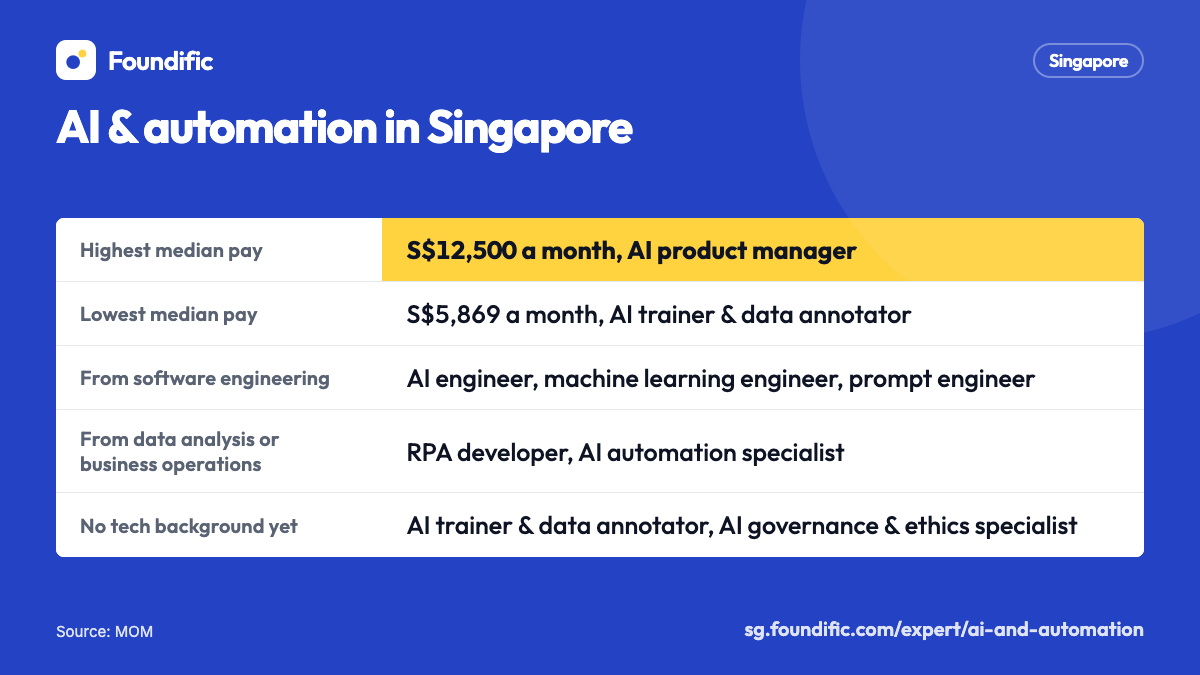
Median gross monthly pay for the closest MOM occupation to each job, highest first.
MOM, Occupational Wages 2025, Table 4 (all industries), June 2025. Full-time resident employees; gross monthly wage, excluding bonuses.
Where to start
From software engineering
AI engineers build software that uses large language models, such as search over company documents and agents. Machine learning engineers build the data pipelines, training code and serving systems that run models on live data.
From data analysis or business operations
Knowing how a business process works is the base for automation. RPA developers build bots that follow fixed rules. AI automation specialists build workflows that connect apps through APIs and use language models to sort, draft or route information.
No tech background yet
AI trainers and data annotators label data and rate model responses against written guidelines. Some of these roles are entry points into wider AI work. AI governance and ethics specialists usually sit in risk, compliance or legal teams.
Jobs
Nothing in AI & automation matches. Try a shorter word.
Building AI systems
Builds software that uses large language models and other AI models to do real work.
Builds software that reads images and video.
Builds chatbots and voice or text assistants that talk with customers, staff or citizens.
Turns data science models into software that runs in production.
Builds software that reads, sorts, searches and writes human language.
Designs the instructions, context and checks that help a large language model (LLM) give useful, reliable answers.
AI infrastructure and data
An AI trainer and data annotator prepares the data that machine learning models learn from.
Makes trained AI models run fast, reliably and at a sensible cost in production.
Gets machine learning models out of notebooks and into production, then keeps them running.
AI research
Designs and runs experiments to build new AI methods or adapt existing ones to business problems.
AI products and adoption
Helps organisations decide where AI will help and how to introduce it.
Decides what an AI-powered product should do, who it is for, and how to tell whether it works.
Builds working software inside a customer's business.
Automation and robotics
Designs and builds workflows that take over repetitive work.
Builds software bots that carry out repetitive computer tasks, such as copying data between systems, filling in forms and sending routine emails.
Designs, builds and tests robots and the software that runs them.
AI safety and governance
An AI governance and ethics specialist helps an organisation use AI safely and within the law.
Attacks AI systems on purpose to find weaknesses before real attackers or users do.
Common questions
Which AI jobs are there in Singapore?
Common jobs include AI engineer, machine learning engineer, prompt engineer, AI automation specialist, RPA developer, AI product manager, and AI trainer and data annotator. The closest official occupation for several is Artificial intelligence/Machine learning engineer (SSOC 25143). The table above lists median pay by job.
Do I need a degree for an AI job?
A degree is one route among several. AI Singapore's AI Apprenticeship Programme is open to Singapore Citizens with a NITEC, diploma or degree who pass its proficiency test. IMDA encourages employers to hire for tech roles based on skills as well as qualifications.
How do I start a career in AI in Singapore?
Routes include an AI degree at NUS or NTU, a polytechnic diploma in applied AI, the AI Apprenticeship Programme, and IMDA TechSkills Accelerator programmes. TeSA's Career Conversion Programme is aimed at professionals, managers, executives and technicians, including mid-career switchers.
Can I use SkillsFuture Credit for AI courses?
Singapore Citizens aged 25 and above can use SkillsFuture Credit on courses listed on the MySkillsFuture portal. Credit eligibility varies by course. The portal lets you browse courses by in-demand skills, including Artificial Intelligence.
Are there rules for AI work in Singapore?
PDPC has issued advisory guidelines on using personal data in AI recommendation and decision systems and in generative AI under the PDPA. IMDA has published Model AI Governance Frameworks for generative AI and for agentic AI. MAS has AI risk management guidelines for financial institutions.
Sources
16 official sources
- Ministry of Digital Development and Information (MDDI), launch of the National AI Strategy 2.0, 4 December 2023
- Infocomm Media Development Authority (IMDA), Skills Framework for Infocomm Technology, consolidated career maps
- Singapore Department of Statistics, Singapore Standard Occupational Classification (SSOC) 2024
- AI Singapore, AI Apprenticeship Programme (AIAP)
- Infocomm Media Development Authority (IMDA), TechSkills Accelerator (TeSA)
- National University of Singapore, Bachelor of Computing in Artificial Intelligence
- Nanyang Technological University, Bachelor of Computing (Hons) in Data Science and Artificial Intelligence
- Temasek Polytechnic, Diploma in Applied Artificial Intelligence (T69)
- Ngee Ann Polytechnic, Diploma in Applied AI & Analytics (N81)
- MySkillsFuture, SkillsFuture Credit
- MySkillsFuture, SkillsFuture Credit portal
- Personal Data Protection Commission (PDPC), Advisory Guidelines on Use of Personal Data in AI Recommendation and Decision Systems (1 March 2024)
- Personal Data Protection Commission (PDPC), Advisory Guidelines on Use of Personal Data in Generative AI (20 July 2026)
- IMDA and AI Verify Foundation, Model AI Governance Framework for Generative AI (30 May 2024)
- MDDI, Singapore launches Model AI Governance Framework for Agentic AI (22 January 2026)
- Monetary Authority of Singapore (MAS), Guidelines on Artificial Intelligence Risk Management for Financial Institutions (7 October 2026)