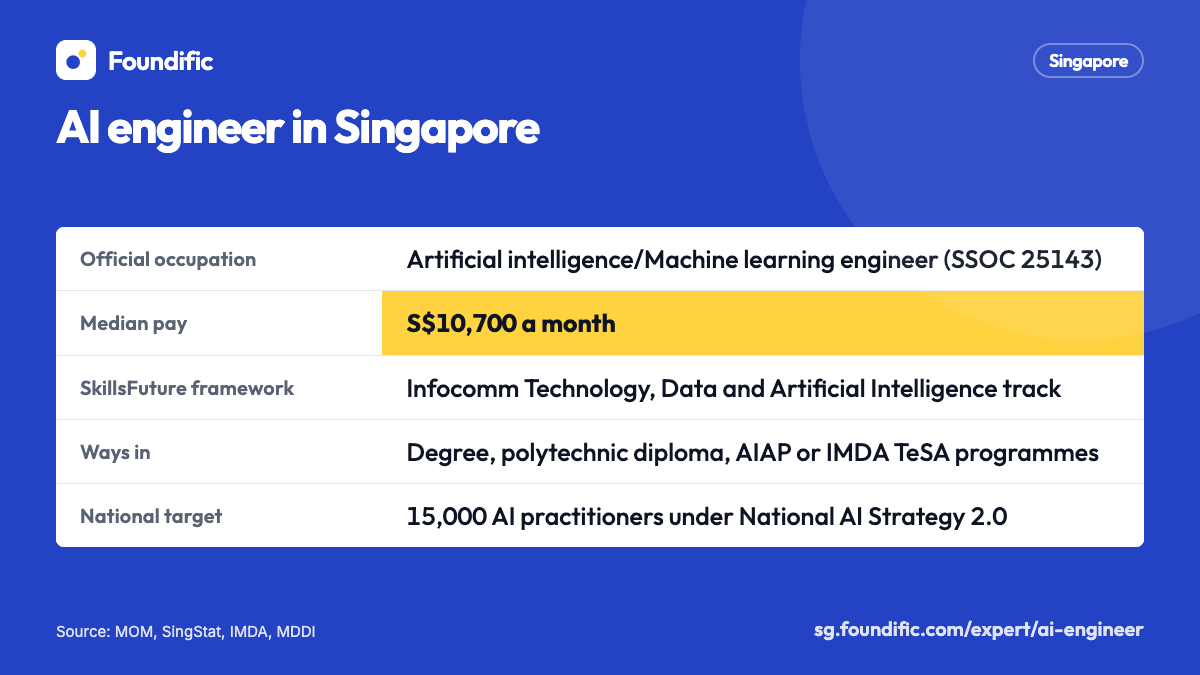
AI engineer in Singapore
- Official occupation: Artificial intelligence/Machine learning engineer (SSOC 25143) SingStat
- SkillsFuture framework: Infocomm Technology, Data and Artificial Intelligence track IMDA
- Ways in: Degree, polytechnic diploma, AIAP or IMDA TeSA programmes
- National target: 15,000 AI practitioners under National AI Strategy 2.0 MDDI
- Data protection law: Personal Data Protection Act 2012 (PDPA) PDPC
What does an AI engineer do?
An AI engineer builds software that uses large language models and other AI models to do real work.
Typical products are search over company documents, chat assistants and agents that carry out tasks across business systems.
The role sits in a technology, data or product team. You find it in sectors such as financial services, healthcare, advanced manufacturing, education and public services. Its closest official occupation is Artificial intelligence/Machine learning engineer (SSOC 25143).
An AI engineer works with data engineers, product managers, designers, security and compliance staff, and the business teams who use the tool.
What the work involves
- Connect an application to a language model through an API and write the prompts and code around it.
- Build retrieval pipelines that load company documents, split them, store them in a vector database and return the right passages.
- Write test sets and scoring checks to measure whether answers are accurate, safe and useful.
- Fix bugs, slow responses and rising costs in AI features that are already live.
- Package services in containers and deploy them to a cloud account with the platform team.
- Tell product and business colleagues what the system can reliably do and where it falls short.
What you might build in your first months
These are our examples of first projects for a new AI engineer.
They are not a promise of what any employer will assign.
| Example | What it involves | Source |
|---|---|---|
| Document search tool with evaluations | Build a retrieval tool over a team's policy documents that cites its sources. Write a test set of real questions and score answers for accuracy before release. | |
| Monitoring for a live AI feature | Add logging and alerts to an existing assistant so the team can see errors, slow responses and token costs. Use the logs to fix the most common failures. | |
| Small agent for an internal task | Build an agent that uses one or two company tools, such as a ticket system, with clear step limits. Package it in Docker and deploy it with the platform team. |
Pay in Singapore
The median is S$10,700 a month, gross.
Closest MOM occupation: Artificial intelligence/Machine learning engineer (SSOC 25143). MOM, Occupational Wages 2025, Table 4 (all industries), June 2025. Full-time resident employees; gross monthly wage, excluding bonuses. Full pay data
Skills an AI engineer needs
Core skills
Retrieval, agents and evaluations are the parts of an AI feature you design yourself.
- RAG
- AI agents
- Evals for AI products
Tools and platforms
Python, model APIs, vector databases, Docker and a cloud platform are what you use each day to build and run those features.
- Python
- LLM APIs
- Vector databases (Pinecone, pgvector)
- LangChain & LlamaIndex
- Docker
- Cloud basics (AWS, Azure, GCP)
AI
AI coding tools speed up routine code, and you remain responsible for reviewing and testing every change they make.
- Claude Code
How to become an AI engineer in Singapore
These are the main routes into AI engineering in Singapore.
Check each official page for current intakes and entry rules.
| Route | What it involves | Source |
|---|---|---|
| University degree | The National University of Singapore (NUS) offers a Bachelor of Computing in Artificial Intelligence. Nanyang Technological University (NTU) offers a degree in Data Science and Artificial Intelligence (DSAI). | NUS NTU |
| Polytechnic diploma | Temasek Polytechnic offers a Diploma in Applied Artificial Intelligence (T69). Ngee Ann Polytechnic offers a Diploma in Applied AI & Analytics (N81), which covers data engineering and machine learning. | Temasek Polytechnic Ngee Ann Polytechnic |
| AI Apprenticeship Programme (AIAP) | AI Singapore runs a full-time apprenticeship of 6 or 9 months at the NTU campus. It starts with 3 months of training, followed by team projects for industry. Entry is through a two-stage technical test. | AI Singapore |
| IMDA career conversion and training | IMDA's TechSkills Accelerator (TeSA) runs Career Conversion Programmes for professionals, including mid-career switchers. It also runs Company-Led Training for new hires and the Tech Immersion and Placement Programme for non-ICT professionals. | IMDA |
| Self-taught with projects | You can learn on your own and show working projects, such as a document search tool with tests. IMDA's Skills-Based Hiring movement asks employers to judge tech applicants on their skills as well as their qualifications. | IMDA |
AI engineer courses and funding in Singapore
These official schemes and programmes can help you learn AI skills in Singapore.
Check each page for current eligibility and course lists before you enrol.
| Course or scheme | What it offers | Source |
|---|---|---|
| SkillsFuture Credit | All Singapore Citizens aged 25 and above get SkillsFuture Credit for courses listed on the MySkillsFuture portal. Citizens aged 40 and above also get a Mid-Career tier for selected courses. The credit can be used on top of other government course subsidies. | MySkillsFuture |
| SkillsFuture Mid-Career Enhanced Subsidy | Singapore Citizens aged 40 and above get higher course fee subsidies on top of the base MOE or SSG subsidy. You must qualify for the base subsidy first. Permanent residents receive the prevailing subsidy levels. | SkillsFuture |
| IMDA TechSkills Accelerator (TeSA) | TeSA runs Career Conversion Programmes for professionals, including mid-career switchers. Its National AI Impact Programme helps existing workers strengthen their AI capabilities. | IMDA |
| AI Singapore AIAP Foundation | AI Singapore offers AIAP Foundation, a self-paced course for people with basic Python skills. It builds core AI fundamentals and prepares applicants for the AI Apprenticeship Programme. | AI Singapore |
| Finding AI courses on MySkillsFuture | The MySkillsFuture portal lets you browse courses by in-demand skills such as Artificial Intelligence and Data Analytics. Courses for the Mid-Career tier carry a label in the course directory. | MySkillsFuture MySkillsFuture |
Where the jobs are
AI engineers work in many sectors.
These national plans and programmes relate to AI work in Singapore.
- National AI Strategy 2.0 was launched on 4 December 2023. MDDI
- The strategy aims to more than triple the number of AI practitioners in Singapore to 15,000. MDDI
- The launch speech gave advanced manufacturing, financial services, healthcare, education and public services as examples of areas for scaling AI use. MDDI
- IMDA's Pinnacle AI Industry Programme supports companies that build or fine-tune their own enterprise large language models. IMDA
Rules and frameworks in Singapore
The Personal Data Protection Act (PDPA) is the law on personal data.
The other items are guidance from the Personal Data Protection Commission (PDPC), IMDA and MAS.
| Rule or framework | What it covers | Source |
|---|---|---|
| PDPC guidelines on personal data in AI recommendation and decision systems | Issued on 1 March 2024. They explain when you can use personal data to build and run machine learning systems, including the business improvement and research exceptions to consent. | PDPC |
| PDPC guidelines on personal data in generative AI | Published on 20 July 2026. They cover personal data when developing models, the duties of model providers, system providers and deployers, and requests for access and correction. They build on the 2024 guidelines. | PDPC |
| Model AI Governance Framework for Generative AI | Released by IMDA and the AI Verify Foundation on 30 May 2024. It sets out 9 dimensions for a trusted environment for generative AI. | IMDA |
| Model AI Governance Framework for Agentic AI | Launched by IMDA on 22 January 2026 and updated on 20 May 2026. It covers four areas: assessing and bounding risks upfront, making humans accountable, technical controls and processes, and end-user responsibility. | IMDA IMDA update |
| AI Verify | A testing framework from the AI Verify Foundation, with testing tools. It helps organisations check their AI systems against 11 internationally recognised AI governance principles, for traditional and generative AI. | AI Verify Foundation |
| MAS Guidelines on Artificial Intelligence Risk Management for Financial Institutions | Published on 7 October 2026 and taking effect on 7 October 2027. They apply to all financial institutions, such as banks, insurers, payment institutions and capital markets firms, and to all forms of AI. | MAS |
AI engineer job description
Singapore employers usually ask an AI engineer to build, test and run software features that use language models, such as document search tools and agents.
The role covers retrieval, evaluations, deployment and monitoring, working with product, data and security teams.
Responsibilities
- Build and maintain applications that call large language models through APIs.
- Design retrieval-augmented generation (RAG) pipelines, including document loading, chunking, embedding and ranking.
- Build AI agents that use tools and company systems, with clear limits on what they may do.
- Write and run evaluations that track answer quality, safety and cost before and after each release.
- Set up and tune vector databases such as pgvector or Pinecone.
- Package services in Docker and deploy them on AWS, Azure or Google Cloud.
- Monitor live systems for errors, delays, cost spikes and poor answers, and fix them.
- Handle personal data in line with the Personal Data Protection Act (PDPA) and company security rules.
- Document designs and explain trade-offs to product managers and business users.
- Review code, including code drafted with AI coding tools, and share good practice with the team.
Requirements
- A degree or diploma in computer science, engineering, data science or a related field, or equivalent practical experience.
- Strong Python skills and comfort with APIs, version control and automated testing.
- Hands-on experience building at least one project with a language model API, such as a RAG tool or agent.
- Working knowledge of Docker and one major cloud platform.
- Our estimate: 1 to 4 years of software or machine learning experience for a mid-level role. Entry-level roles may accept strong projects instead.
- Clear written and spoken English for working with non-technical teams.
AI engineer career path
AI engineering is a newer field, so titles vary between employers.
The ladder below shows common steps in Singapore, from building features to setting AI direction.
Junior AI engineer
Entry
You build parts of AI features under guidance, write tests and learn the team's tools and review process.
AI engineer
Mid
You own whole features, from retrieval design to deployment, and work directly with product managers.
Senior AI engineer
Senior
You set technical designs, define how quality is measured and guide less experienced engineers.
Lead AI engineer
Lead
You lead a small team, plan delivery across projects and agree on risk controls with security and compliance.
Head of AI
Head
You set the AI strategy, choose build-or-buy options, manage budgets and report to senior leadership.
The titles are ones commonly used in Singapore; employers may name the levels differently.
Related jobs and their pay
| Related job | Median pay a month | Why it is related |
|---|---|---|
| Machine learning engineer | Same MOM occupation | You move closer to model training and tuning, which suits engineers who want to work below the API layer. |
| MLOps engineer | Same MOM occupation | Your Docker, cloud and monitoring skills carry over to running model pipelines at scale. |
| AI product manager | S$12,500 | If you enjoy deciding what to build and how to measure it, your testing experience gives you credibility. |
| Forward-deployed engineer | Same MOM occupation | You build AI solutions on site with clients, which suits engineers who like customer contact. |
MOM Occupational Wages 2025, gross monthly wage, full-time resident employees. Each figure links to its salary guide.
AI engineer interview questions
We wrote these questions from the skills this job needs. They are not an official question bank.
Walk me through how you would build a RAG system over a company's policy documents.
What a good answer covers
- Covers loading, cleaning, chunking and embedding, with reasons for chunk size and overlap
- Explains retrieval choices such as hybrid search and reranking
- Describes how the model is told to answer only from retrieved passages and to cite them
- Mentions how to refresh the index when documents change
- Names how quality will be measured
When would you choose pgvector over a managed service like Pinecone, and what would change your mind?
What a good answer covers
- Compares data size, query volume and existing infrastructure
- Notes that pgvector keeps vectors beside other relational data
- Considers operations effort, scaling and cost
- Mentions filtering by metadata and access rights
- Gives a clear trigger for switching
How would you test whether a new prompt or model makes your assistant better?
What a good answer covers
- Builds a test set from real questions with agreed correct answers
- Uses a mix of automated checks, model-based grading and human review
- Tracks accuracy, refusals, delay and cost together
- Compares old and new versions on the same set
- Explains how to avoid overfitting to the test set
Your agent can call several tools and sometimes loops or picks the wrong one. How do you debug and fix it?
What a good answer covers
- Logs each step, tool call and result so runs can be replayed
- Checks tool names, descriptions and input formats for ambiguity
- Adds step limits, timeouts and clear stop conditions
- Reduces the number of tools or splits the task into smaller steps
- Adds test cases for each failure found
A language model API call fails or is slow during peak hours. How do you make your service dependable?
What a good answer covers
- Sets timeouts and retries with backoff
- Handles rate limits with queues or batching
- Caches repeated requests where answers allow it
- Uses a fallback model or a clear error message
- Tracks delay, error rates and token use
When would you use LangChain or LlamaIndex, and when would you call the model API directly?
What a good answer covers
- Explains that frameworks speed up common patterns such as loaders and retrievers
- Notes the cost: extra layers, version changes and harder debugging
- Prefers direct calls for simple flows
- Describes how to keep framework code easy to replace
- Gives an example from own work
How would you package and deploy an AI service so another engineer can run it the same way?
What a good answer covers
- Writes a Dockerfile with pinned dependencies and a small image
- Keeps keys and settings out of the image and uses a secrets store
- Describes deployment on AWS, Azure or Google Cloud, for example a container service
- Adds health checks, logs and a rollback plan
- Uses a CI pipeline to build and test
How do you use an AI coding tool such as Claude Code in your work, and how do you check what it produces?
What a good answer covers
- Gives it clear tasks and context, and reviews every change
- Runs tests and reads the diff before merging
- Avoids pasting secrets or personal data into prompts
- Knows when to write the code by hand
- Can describe a case where the tool was wrong
A customer-facing chatbot gave a wrong answer about a refund policy, and a customer complained. What do you do?
What a good answer covers
- Reproduces the case and checks what was retrieved and what the model said
- Finds the cause: missing document, poor retrieval or weak instructions
- Fixes it and adds the case to the test set
- Considers tighter controls such as citations, refusals when unsure or human handover
- Reports to the business owner in simple, non-technical language
Your monthly model usage bill has doubled and the product manager wants to know why. How do you investigate?
What a good answer covers
- Breaks usage down by feature, user and prompt length
- Looks for long contexts, repeated calls and retry loops
- Tests smaller models or shorter prompts against the quality checks
- Adds caching and usage limits
- Sets up alerts so spikes show early
The business wants an agent that can issue refunds on its own. How would you design it?
What a good answer covers
- Starts with a limited scope and low-value cases
- Requires human approval above a set threshold
- Logs every action with a reason and keeps an audit trail
- Tests with simulated cases before launch
- Plans a way to switch the agent off quickly
Tell me about a time you disagreed with a product manager about launching an AI feature.
What a good answer covers
- Describes the situation and the risk clearly
- Uses test results or examples instead of opinion
- Offers options such as a limited release
- Shows respect for the other view
- States the outcome and what was learned
Describe a time you explained an AI limitation to someone who wanted more than the system could deliver.
What a good answer covers
- Uses plain language and an example
- Separates what works reliably from what does not
- Proposes a realistic alternative
- Follows up with evidence after the change
Users may paste NRIC numbers or home addresses into your chatbot. How do you handle this under the Personal Data Protection Act (PDPA)?
What a good answer covers
- Limits what personal data is collected and used, and states the purpose
- Masks or removes personal data before it is sent to a model provider where possible
- Checks where the provider processes and stores data, and the contract terms
- Sets retention limits for logs and conversation history
- Involves the company's data protection officer
You are building an AI tool for a bank in Singapore. What extra controls would you expect from MAS-regulated firms?
What a good answer covers
- Expects governance and clear ownership of each AI use case
- Documents data sources, testing and known limits
- Checks for fairness and explainability where decisions affect customers
- Keeps human oversight for higher-risk uses
- Says they would confirm current MAS requirements with the compliance team
Common questions about an AI engineer job
Is AI engineer an official occupation in Singapore?
Yes. The Singapore Standard Occupational Classification (SSOC) 2024 lists Artificial intelligence/Machine learning engineer under code 25143. The SkillsFuture Skills Framework for Infocomm Technology places the role in its Data and Artificial Intelligence track.
Do you need an AI degree to become an AI engineer?
No single degree is required. Degrees and polytechnic diplomas are common routes, and AI Singapore's AIAP and IMDA's TeSA programmes also lead into AI roles. Working projects help show your skills.
What is the AI Apprenticeship Programme?
It is a full-time programme of 6 or 9 months run by AI Singapore at the NTU campus. You train for 3 months, then work in teams on industry projects. Applicants must pass a two-stage technical test.
Which rules apply to AI work in Singapore?
The PDPA covers any personal data your system uses. PDPC has advisory guidelines for AI systems and for generative AI. IMDA publishes model governance frameworks, and MAS has AI risk guidelines for financial institutions.
What is Singapore's national target for AI practitioners?
National AI Strategy 2.0, launched in December 2023, aims to more than triple the number of AI practitioners in Singapore to 15,000.
What does an AI engineer do?
An AI engineer builds and runs software that uses AI models, mostly language models. The work covers retrieval, agents, testing, deployment and monitoring. It is closer to software engineering than to research.
What is the difference between an AI engineer and a machine learning engineer?
An AI engineer usually builds products on top of existing models through APIs. A machine learning engineer more often trains, tunes and serves models. Job titles overlap, so read the ad's task list.
How much does an AI engineer earn in Singapore?
Pay depends on experience, the employer and the sector. The MOM figures on the overview page for this job give a better picture than any single number.
Do you need a course to become an AI engineer?
No course is required. Employers look for Python skills, working projects and an understanding of how to test AI systems. A course can help you structure your learning, and a portfolio of working projects shows what you can build.
Sources
21 official sources
- Singapore Department of Statistics, Singapore Standard Occupational Classification (SSOC) 2024
- Skills and Workforce Development Agency (SWDA), SkillsFuture Skills Framework
- Infocomm Media Development Authority (IMDA), Skills Framework for Infocomm Technology, consolidated career maps
- Infocomm Media Development Authority (IMDA), TechSkills Accelerator (TeSA)
- Ministry of Digital Development and Information (MDDI), launch of the National AI Strategy 2.0, 4 December 2023
- Personal Data Protection Commission (PDPC), Advisory Guidelines on Use of Personal Data in Generative AI (20 July 2026)
- National University of Singapore, Bachelor of Computing in Artificial Intelligence
- Temasek Polytechnic, Diploma in Applied Artificial Intelligence (T69)
- AI Singapore, AI Apprenticeship Programme (AIAP)
- Personal Data Protection Commission (PDPC), Advisory Guidelines on Use of Personal Data in AI Recommendation and Decision Systems (1 March 2024)
- IMDA and AI Verify Foundation, Model AI Governance Framework for Generative AI (30 May 2024)
- MDDI, Singapore launches Model AI Governance Framework for Agentic AI (22 January 2026)
- IMDA, Updated Model AI Governance Framework for Agentic AI (20 May 2026)
- AI Verify Foundation, What is AI Verify
- Monetary Authority of Singapore (MAS), Guidelines on Artificial Intelligence Risk Management for Financial Institutions (7 October 2026)
- Nanyang Technological University, Bachelor of Computing (Hons) in Data Science and Artificial Intelligence
- Ngee Ann Polytechnic, Diploma in Applied AI & Analytics (N81)
- MySkillsFuture, SkillsFuture Credit
- SkillsFuture Singapore, SkillsFuture Mid-Career Enhanced Subsidy FAQ
- MySkillsFuture, SkillsFuture Credit portal
- AI Singapore, AI Apprenticeship Programme (AIAP)