Data analyst in Singapore
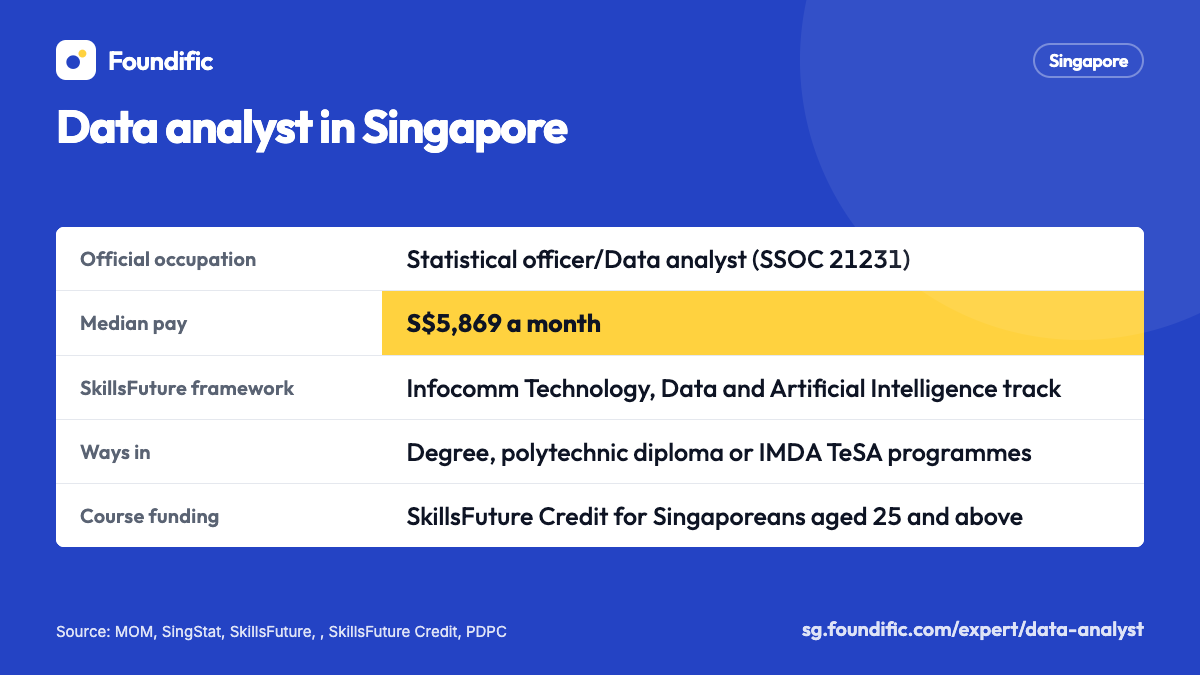
- Official occupation: Statistical officer/Data analyst (SSOC 21231) SingStat
- SkillsFuture framework: Infocomm Technology, Data and Artificial Intelligence track SkillsFuture
- Ways in: Degree, polytechnic diploma or IMDA TeSA programmes IMDA
- Course funding: SkillsFuture Credit for Singaporeans aged 25 and above SkillsFuture Credit
- Data protection law: Personal Data Protection Act 2012 (PDPA) PDPC
What does a data analyst do?
A data analyst collects, cleans and studies data to help an organisation make decisions.
You turn raw figures from sales systems, surveys, web tools and databases into reports, dashboards and clear recommendations.
Data analysts work in sectors such as banking, government, retail, logistics, healthcare and technology. You usually report to an analytics manager, a head of data, or a business function such as finance or marketing.
You work with managers who ask the questions, data engineers who maintain the data pipelines, and data scientists who build models. You also explain findings to people who do not work with data.
What the work involves
- Meet business teams to understand what they need to know, and turn the request into a clear analysis question.
- Pull data from internal databases, spreadsheets and outside sources, then check it for errors, gaps and duplicates.
- Clean and combine the data using SQL, Excel or Python so it is ready to analyse.
- Run the analysis, such as trends, comparisons or A/B test results, and note what the numbers show and where they fall short.
- Build dashboards and reports in a tool such as Power BI or Tableau, and update them on a schedule.
- Present findings in everyday business language and suggest the next action.
What you might build in your first months
These are our examples of first projects for a new data analyst.
Real tasks depend on the employer.
| Example | What it involves | Source |
|---|---|---|
| Rebuild a monthly report | Take a report that is put together by hand in Excel and rebuild it with SQL and a dashboard tool so it refreshes on a schedule. | |
| Write down the key definitions | Agree with finance and business teams how measures such as sales, active customers and returns are counted, and document them. | |
| Answer one business question | Take a question such as why sign-ups fell last quarter, analyse it from source data and present the findings with a suggested next step. |
Pay in Singapore
The median is S$5,869 a month, gross.
Closest MOM occupation: Statistical officer/Data analyst (SSOC 21231). MOM, Occupational Wages 2025, Table 4 (all industries), June 2025. Full-time resident employees; gross monthly wage, excluding bonuses. Full pay data
Skills a data analyst needs
Core skills
Analysis, statistics, charts and A/B tests are how you turn raw data into an answer a manager can act on.
- Data analysis
- Statistics
- Data visualisation
- A/B testing
Tools and platforms
SQL, Excel, a dashboard tool and Python are what you use each day to pull, clean and present data.
- SQL
- Excel
- Excel Power Query
- Power BI
- Tableau
- Looker Studio
- Python
AI
AI chat tools can draft SQL and explain code, and you check every result against the real data.
- ChatGPT
How to become a data analyst in Singapore
These are the main routes into data analysis in Singapore.
Check each official page for current intakes and entry rules.
| Route | What it involves | Source |
|---|---|---|
| University degree | For cohorts from AY2026/27, the National University of Singapore (NUS) offers a Bachelor of Science (Honours) in Data Science and Applied AI, with courses in computing, mathematics and statistics. Nanyang Technological University (NTU) offers a degree in Data Science and Artificial Intelligence. | NUS NTU |
| Polytechnic diploma | Ngee Ann Polytechnic offers a Diploma in Applied AI & Analytics (N81), formerly the Diploma in Data Science. It covers data extraction, data wrangling and machine learning. | Ngee Ann Polytechnic |
| IMDA career conversion and training | IMDA's TechSkills Accelerator (TeSA) runs Career Conversion Programmes for professionals, including mid-career switchers. It also runs the Tech Immersion and Placement Programme for non-ICT professionals. | IMDA |
| Funded short courses | You can take data analytics courses listed on the MySkillsFuture portal and pay part of the fee with SkillsFuture Credit. | MySkillsFuture SkillsFuture Credit |
| Self-taught with projects | You can learn SQL and a dashboard tool on your own and show finished analyses. IMDA's Skills-Based Hiring movement asks employers to judge tech applicants on their skills as well as their qualifications. | IMDA |
Data analyst courses and funding in Singapore
These official schemes help pay for data courses in Singapore.
Check each page for current eligibility.
| Course or scheme | What it offers | Source |
|---|---|---|
| SkillsFuture Credit | Singaporeans receive an opening credit when they turn 25. It does not expire and can be used on eligible courses listed on the MySkillsFuture portal. | SkillsFuture Credit |
| Mid-career SkillsFuture Credit | On 1 May 2024, the Government gave Singaporeans aged 40 and above an extra SkillsFuture Credit (Mid-Career). | SkillsFuture Credit |
| Course fee funding | SkillsFuture Singapore funds part of the fee for courses it supports. Singapore Citizens aged 40 and above can get higher subsidies under the Mid-Career Enhanced Subsidy. | SkillsFuture |
| IMDA TechSkills Accelerator (TeSA) | TeSA programmes train professionals for tech roles, including career conversion for mid-career switchers. | IMDA |
| Finding courses on MySkillsFuture | Search the MySkillsFuture portal for terms such as data analytics, SQL or Power BI. Each listing shows the provider, the dates and whether SkillsFuture Credit applies. | MySkillsFuture |
Where the jobs are
Data analysts work in most sectors that keep business records.
These official facts relate to data work in Singapore.
- The SkillsFuture Skills Framework for Infocomm Technology places the data analyst role in its Data and Artificial Intelligence track. SkillsFuture
- National AI Strategy 2.0 was launched on 4 December 2023. MDDI
- The launch speech gave advanced manufacturing, financial services, healthcare, education and public services as examples of areas for scaling AI use. MDDI
Rules and frameworks in Singapore
The Personal Data Protection Act (PDPA) is the law on personal data.
The other items are guidance from the Personal Data Protection Commission (PDPC).
| Rule or framework | What it covers | Source |
|---|---|---|
| Personal Data Protection Act 2012 (PDPA) | The law that governs how organisations collect, use and disclose personal data in Singapore. It applies to customer and staff data used in analysis. | PDPC |
| Guide on Managing and Notifying Data Breaches Under the PDPA | Published by PDPC on 13 September 2021. It explains how organisations manage data breaches and when they must notify PDPC. | PDPC |
| Guide to Basic Anonymisation | PDPC announced this guide on 30 May 2022. It covers basic anonymisation of datasets. | PDPC |
| PDPC guidelines on personal data in AI recommendation and decision systems | Issued on 1 March 2024. They explain when you can use personal data to build and run machine learning systems, including the business improvement and research exceptions to consent. | PDPC |
| PDPC guidelines on personal data in generative AI | Published on 20 July 2026. They cover personal data in generative AI, including the duties of organisations that deploy these systems. They are advisory and not legally binding. | PDPC |
Data analyst job description
A data analyst gathers data from internal systems and outside sources, checks its quality and analyses it to answer business questions.
The role produces reports, dashboards and recommendations for teams such as marketing, operations, finance and product.
Responsibilities
- Work with business teams to define questions and turn them into reporting and analysis requirements.
- Recommend which data and data sources are needed to answer each question.
- Extract data from databases, files and external sources using SQL and other tools.
- Clean, transform and validate data, and run quality checks before analysis.
- Analyse trends, segments and experiments using statistics and suitable methods.
- Design and maintain dashboards and automated reports that people can read without help.
- Explain results in clear language and recommend actions to managers and other decision makers.
- Document data definitions, calculations and assumptions so others can reproduce the work.
- Handle personal and sensitive data according to company policy and Singapore data protection rules.
- Support data engineers and data scientists on shared datasets and data models.
Requirements
- Diploma or degree in a field such as statistics, mathematics, computer science, information systems, business or economics. Some employers accept equivalent experience or a data analytics programme.
- Typically 0 to 3 years of experience for an analyst role. Entry-level roles often accept fresh graduates with project or internship work.
- Working SQL for querying, joining and summarising data, and strong Excel skills.
- Experience with at least one dashboard tool such as Power BI, Tableau or Looker Studio.
- Basic statistics, and Python or R for larger or repeated analysis, are often listed as useful or required.
- Clear communication, and the ability to explain numbers to people outside the data team.
Data analyst career path
Most data analysts start in an associate or junior analyst role and move up through senior analyst to team lead.
Some later move into management or into more technical data roles.
Associate data analyst / associate data engineer
Entry · SkillsFuture title
You prepare and clean data, build basic reports and learn the business and its data sources under guidance.
Data analyst
Mid · SkillsFuture title
You own analyses from request to presentation, design dashboards and advise business teams on what the data says.
Senior data analyst
Senior
You handle the hardest questions, set standards for data quality and coach junior analysts.
Analytics manager
Lead
You lead a team of analysts, agree priorities with business heads and manage reporting and delivery.
Head of analytics
Head
You set the data and analytics direction for the organisation and report on results to senior leaders.
Steps marked "SkillsFuture title" follow the career pathway in the SkillsFuture Skills Framework. The others are titles commonly used in Singapore.
Related jobs and their pay
| Related job | Median pay a month | Why it is related |
|---|---|---|
| Data scientist | S$10,111 | If you enjoy statistics and modelling, you can move into prediction and machine learning with more Python and maths. |
| Business intelligence (BI) analyst | S$8,445 | Your dashboard and reporting skills transfer directly to a role focused on BI tools and company-wide reporting. |
| Data engineer | S$8,721 | If you prefer building pipelines and databases to analysing results, your SQL and data cleaning work is a good base. |
| Analytics engineer | S$8,721 | You can move into building clean, tested data models that other analysts use, with SQL and version control at the centre. |
MOM Occupational Wages 2025, gross monthly wage, full-time resident employees. Each figure links to its salary guide.
Data analyst interview questions
We wrote these questions from the skills this job needs. They are not an official question bank.
Write a SQL query to find the top three customers by spend in each month. How would you do it?
What a good answer covers
- Aggregates spend by customer and month first
- Uses a window function such as RANK or ROW_NUMBER partitioned by month
- Explains how ties are handled and why
- Filters on the rank in an outer query or common table expression
You join an orders table to a customers table and the row count goes up. What could be wrong?
What a good answer covers
- Checks whether the join key is unique in each table
- Explains that duplicate keys multiply rows
- Compares row counts before and after the join
- Describes how to fix it by deduplicating or aggregating first
- Knows when to use a left join instead of an inner join
A manager asks what a p-value and a confidence interval mean. How do you explain them without jargon?
What a good answer covers
- Describes the p-value as how surprising the result would be if there were no real effect
- Describes the interval as a range of plausible values for the true figure
- Avoids saying the p-value is the chance the result is true
- Mentions that a small effect can be significant with a large sample
- Relates it to a business decision
You run an A/B test on a checkout page. How do you decide the sample size and when to stop?
What a good answer covers
- Defines one main metric and the smallest change worth detecting
- Estimates sample size before the test starts
- Waits for the planned sample instead of stopping when the result looks good
- Checks that users are split randomly and evenly
- Considers business cycles such as weekday and weekend behaviour
You receive a survey file with missing values, duplicate responses and inconsistent text entries. What steps do you take?
What a good answer covers
- Profiles the data first to see how large each problem is
- Removes or flags duplicates with a clear rule
- Standardises text categories and formats
- Decides whether to drop, fill or keep missing values, and explains why
- Keeps a log of every change so the work can be repeated
You need to show monthly revenue by region to senior managers. Which chart do you choose and how do you lay out the dashboard?
What a good answer covers
- Chooses a line chart for trend and a bar chart for comparison
- Limits the number of colours and removes clutter
- Puts the main message in the title
- Adds filters only where users need them
- Tests the layout with a real user
Twelve monthly Excel files arrive with the same layout every month. How do you combine them without copying and pasting?
What a good answer covers
- Uses Power Query to load all files from a folder
- Applies the same cleaning steps to every file
- Sets data types and removes header rows consistently
- Refreshes the query when a new file is added
- Explains how to handle a file with a changed column name
In Python, how would you merge two datasets, summarise them by group and spot outliers?
What a good answer covers
- Uses pandas merge with a clear key and checks the result size
- Uses groupby with named aggregations
- Checks for outliers with summary statistics, box plots or an interquartile range rule
- Investigates whether an outlier is an error or a real value before removing it
Your dashboard shows a different sales total from the finance team's report. What do you do?
What a good answer covers
- Compares definitions first, such as gross or net sales and date cut-offs
- Traces the numbers back to the source tables
- Checks filters, currency and refresh timing
- Agrees one definition with finance and documents it
- Tells stakeholders about the gap before they find it
A manager asks you why sales dropped last month, with no other detail. How do you approach it?
What a good answer covers
- Asks what decision the answer will support
- Confirms the drop is real by checking against past months
- Breaks the figure down by product, region, channel and customer type
- Forms a few possible explanations and tests each with data
- Reports what is known, what is not, and a suggested next step
A colleague suggests pasting a customer dataset into ChatGPT to speed up your analysis. What do you say?
What a good answer covers
- Checks company policy on approved AI tools first
- Keeps personal and confidential data out of public tools
- Suggests using sample, masked or synthetic data instead
- Says AI output must be checked against the real data
- Describes where AI does help, such as drafting SQL or explaining code
Tell us about a time your analysis changed someone's mind or a decision.
What a good answer covers
- Describes the situation and the original view
- Explains what data and method you used
- Shows how you presented it for the audience
- States the result of the decision
Describe a time you found a mistake in your own work after you had shared it.
What a good answer covers
- Tells the stakeholders quickly and clearly
- Explains the cause and the fix
- Describes the check you added to prevent it happening again
- Takes ownership of the error
You are given a customer file that contains NRIC numbers, phone numbers and email addresses for an analysis. How do you handle it under Singapore data protection rules?
What a good answer covers
- Names the Personal Data Protection Act (PDPA) as the law that governs personal data
- Uses only the fields the analysis needs
- Masks or removes identifiers such as NRIC numbers before analysis
- Limits access and storage, and follows the retention rules of the company
- Checks with the data protection officer when unsure
You are analysing weekly sales for a Singapore retailer. How do you account for local events and seasons?
What a good answer covers
- Marks festive periods such as Chinese New Year and Hari Raya
- Includes school holidays, public holidays and year-end sales
- Compares with the same period in earlier years as well as the previous week
- Separates one-off promotions from the usual trend
- Tells the business how much of a change is seasonal
Common questions about a data analyst job
Is data analyst an official occupation in Singapore?
Yes. The Singapore Standard Occupational Classification (SSOC) lists Statistical officer/Data analyst under code 21231. The SkillsFuture Skills Framework for Infocomm Technology places the role in its Data and Artificial Intelligence track.
Do you need a degree to become a data analyst?
No single degree is required. Degrees and polytechnic diplomas are common routes, and IMDA's TeSA programmes help professionals convert into tech roles. Finished analyses using SQL and a dashboard tool help show your skills.
Can you use SkillsFuture Credit for data analytics courses?
Yes, for eligible courses listed on the MySkillsFuture portal. Singaporeans receive an opening credit when they turn 25, and on 1 May 2024 those aged 40 and above received an extra mid-career credit.
Which rules apply to data analysis in Singapore?
The PDPA covers any personal data you analyse. PDPC publishes guides on managing data breaches and on anonymising data, and advisory guidelines on personal data in AI systems.
Can you put customer data into an AI chat tool?
Check your organisation's policy first. Personal data stays covered by the PDPA, and PDPC's 2026 guidelines on generative AI set out the duties of organisations that deploy these tools.
What does a data analyst do?
A data analyst gathers and cleans data, analyses it and presents the results as reports, dashboards and recommendations. The aim is to help a team make a better decision, such as how to price a product or where to fix a process.
Do you need a degree to become a data analyst in Singapore?
Many employers ask for a diploma or degree in a related field, but requirements differ by organisation. A portfolio of projects, SQL skills and a data analytics course can help if your degree is in another subject.
Which tools do data analysts use?
Most data analysts use SQL and Excel every week. Many also use Power BI, Tableau or Looker Studio for dashboards, and Python for cleaning and analysing larger datasets.
What is the difference between a data analyst and a data scientist?
A data analyst mainly explains what has happened and why, using reports and statistical analysis. A data scientist more often builds predictive models and works with machine learning. The two roles overlap, and many scientists start as analysts.
Sources
15 official sources
- Skills and Workforce Development Agency (SWDA), SkillsFuture Skills Framework
- Singapore Department of Statistics, Singapore Standard Occupational Classification (SSOC) 2024
- SkillsFuture Singapore, MySkillsFuture portal
- SkillsFuture Singapore, SkillsFuture Credit
- SkillsFuture Singapore, SkillsFuture Mid-Career Enhanced Subsidy
- Personal Data Protection Commission (PDPC), Personal Data Protection Act 2012
- Personal Data Protection Commission (PDPC), Guide on Managing and Notifying Data Breaches Under the PDPA (13 September 2021)
- Personal Data Protection Commission (PDPC), Guide to Basic Anonymisation (30 May 2022)
- Personal Data Protection Commission (PDPC), Advisory Guidelines on Use of Personal Data in AI Recommendation and Decision Systems (1 March 2024)
- Personal Data Protection Commission (PDPC), Advisory Guidelines on Use of Personal Data in Generative AI (20 July 2026)
- National University of Singapore, Department of Data Science and Statistics, B.Sc. (Hons) in Data Science and Applied AI, requirements for cohorts AY2026/27 and after
- Nanyang Technological University, Bachelor of Computing (Hons) in Data Science and Artificial Intelligence
- Ngee Ann Polytechnic, Diploma in Applied AI & Analytics (N81)
- Infocomm Media Development Authority (IMDA), TechSkills Accelerator (TeSA)
- Ministry of Digital Development and Information (MDDI), launch of the National AI Strategy 2.0, 4 December 2023