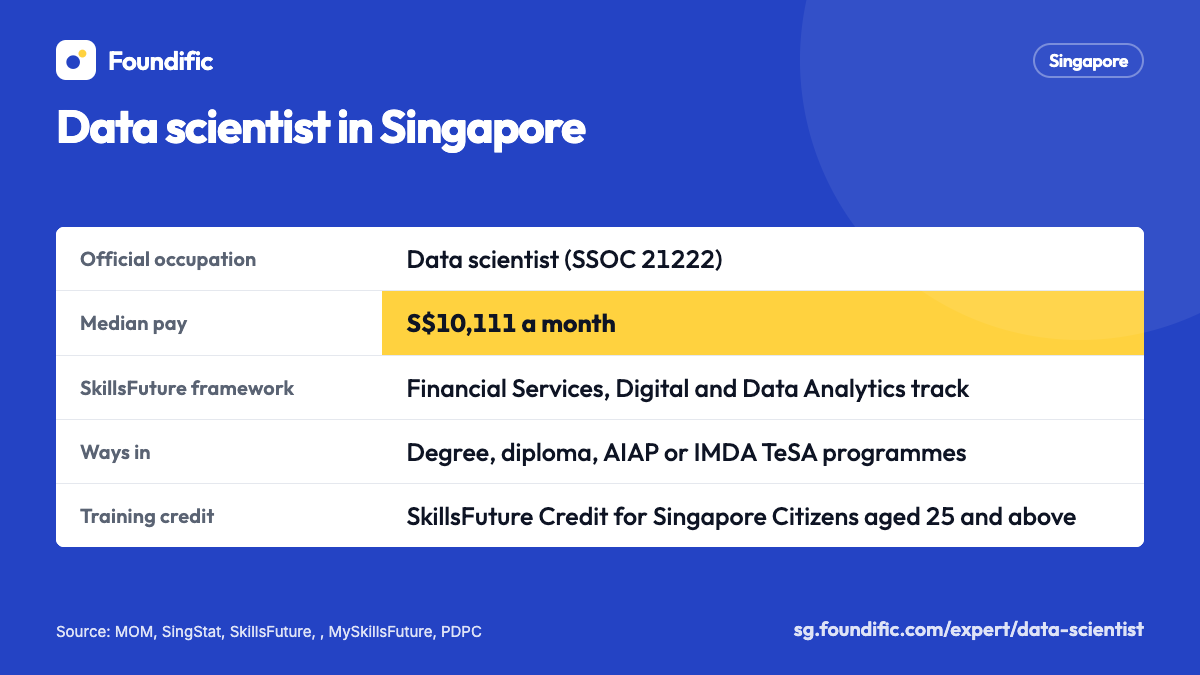
Data scientist in Singapore
- Official occupation: Data scientist (SSOC 21222) SingStat
- SkillsFuture framework: Financial Services, Digital and Data Analytics track SkillsFuture
- Ways in: Degree, diploma, AIAP or IMDA TeSA programmes IMDA
- Training credit: SkillsFuture Credit for Singapore Citizens aged 25 and above MySkillsFuture
- Data protection law: Personal Data Protection Act 2012 (PDPA) PDPC
What does a data scientist do?
A data scientist uses statistics, programming and machine learning to find patterns in data.
The work covers analysis, predictive models and clear reports for people who do not write code.
In Singapore, data scientists work in banks, insurers, government agencies, healthcare, logistics, e-commerce and telecoms. Most sit in a data or analytics team, which often reports to a head of data or a chief data officer.
You work with business owners who set the questions, data engineers who supply clean data, and software engineers who put models into products. Senior data scientists also mentor junior staff and guide team standards.
What the work involves
- Pull and clean data from internal systems and outside sources, then check that it is complete and accurate.
- Explore the data in Python or SQL to find patterns, gaps and likely drivers of a business problem.
- Build, test and tune models, such as forecasts, classifiers or text models, and measure how well they work.
- Design experiments, such as A/B tests, to check whether a change really made a difference.
- Present findings with charts and plain-language summaries to managers and other non-technical colleagues.
- Review junior colleagues' code and models, and agree on shared tools and ways of working.
What you might build in your first months
These are our examples of first projects.
Real work depends on the team and the data.
| Example | What it involves | Source |
|---|---|---|
| Churn or demand forecast | Build a simple model on past records, compare it with a basic baseline and write up how accurate it is. | |
| A/B test review | Check how a past experiment was set up, rerun the analysis and explain to the product team what the result means. | |
| Data quality check | Profile a key dataset for gaps and errors, note which fields hold personal data, and agree fixes with the data engineers. |
Pay in Singapore
The median is S$10,111 a month, gross.
MOM, Occupational Wages 2025, Table 4 (all industries), June 2025. Full-time resident employees; gross monthly wage, excluding bonuses. Full pay data
Skills a data scientist needs
Core skills
Statistics, experiment design and machine learning let you judge whether a pattern is real and whether a model will hold up.
- Statistics
- Machine learning
- Experiment design
- Feature engineering
Tools and platforms
Python, SQL and notebooks are where you pull, clean and model data each day. Spark or Databricks help when the data is too large for one machine.
- Python
- Pandas & Jupyter
- Scikit-learn
- SQL
- R
- Spark & Databricks
AI
Model APIs and AI coding tools speed up text work and routine code, and you remain responsible for checking every result they give.
- LLM APIs
How to become a data scientist in Singapore
These are the main routes into data science in Singapore.
Check each official page for current intakes and entry rules.
| Route | What it involves | Source |
|---|---|---|
| University degree | Nanyang Technological University (NTU) offers a Bachelor of Computing (Hons) in Data Science and Artificial Intelligence. It gives training in statistics, computing and AI. | NTU |
| Polytechnic diploma | Ngee Ann Polytechnic offers a Diploma in Applied AI & Analytics (N81), formerly its Diploma in Data Science. It covers data engineering and machine learning. | Ngee Ann Polytechnic |
| AI Apprenticeship Programme (AIAP) | AI Singapore runs a full-time apprenticeship of 6 or 9 months at the NTU campus. It starts with 3 months of training, followed by team projects for industry. Entry is through a two-stage technical test. | AI Singapore |
| IMDA career conversion and training | IMDA's TechSkills Accelerator (TeSA) runs Career Conversion Programmes for professionals, including mid-career switchers. It also runs Company-Led Training for new hires and the Tech Immersion and Placement Programme for non-ICT professionals. | IMDA |
| Self-taught with projects | You can learn on your own and show working analyses, such as a forecast with a written report. IMDA's Skills-Based Hiring movement asks employers to judge tech applicants on their skills as well as their qualifications. | IMDA |
Data scientist courses and funding in Singapore
These official schemes help Singaporeans pay for courses.
Check each page for current rules.
| Course or scheme | What it offers | Source |
|---|---|---|
| SkillsFuture Credit | All Singapore Citizens aged 25 and above get SkillsFuture Credit. It can be used for courses listed on the MySkillsFuture portal, on top of other government course subsidies. You submit your claim online before the course starts. | MySkillsFuture |
| SkillsFuture Credit (Mid-Career) | Singapore Citizens aged 40 and above get a further credit. It can only be used for selected courses, such as full qualifications from Institutes of Higher Learning and shorter modules that stack to one. | MySkillsFuture |
| SkillsFuture Mid-Career Enhanced Subsidy | Singapore Citizens aged 40 and above get higher course fee subsidies for supported courses. You must first qualify for the baseline course fee funding. | MySkillsFuture |
| Finding courses on MySkillsFuture | Search the MySkillsFuture portal for data science, Python or machine learning courses. Courses listed there can be paid for with SkillsFuture Credit. | MySkillsFuture |
| IMDA TechSkills Accelerator (TeSA) | IMDA's TeSA programmes include Career Conversion Programmes for mid-career switchers and Company-Led Training for new hires in tech roles. | IMDA |
Where the jobs are
Data scientists work in many sectors.
These official facts relate to data and AI work in Singapore.
- The SkillsFuture Skills Framework lists Data Scientist in the Financial Services sector, in the Digital and Data Analytics track. SkillsFuture
- National AI Strategy 2.0 was launched on 4 December 2023. MDDI
- The strategy aims to more than triple the number of AI practitioners in Singapore to 15,000. MDDI
- The launch speech gave advanced manufacturing, financial services, healthcare, education and public services as examples of areas for scaling AI use. MDDI
Rules and frameworks in Singapore
The Personal Data Protection Act (PDPA) is the law on personal data.
The other items are guidance from the Personal Data Protection Commission (PDPC) and MAS.
| Rule or framework | What it covers | Source |
|---|---|---|
| Personal Data Protection Act 2012 (PDPA) | Sets obligations for organisations that collect, use or disclose personal data. They include consent, purpose limitation, protection, retention limitation and data breach notification. PDPC's Key Concepts guidelines were last revised on 29 April 2026. | PDPC |
| PDPC guidelines on personal data in AI recommendation and decision systems | Issued on 1 March 2024. They explain when you can use personal data to build and run machine learning systems, including the business improvement and research exceptions to consent. | PDPC |
| PDPC guidelines on personal data in generative AI | Published on 20 July 2026. They cover personal data when developing and deploying generative AI, and requests for access and correction. They build on the 2024 guidelines. | PDPC |
| AI Verify | A testing framework from the AI Verify Foundation, with testing tools. It helps organisations check their AI systems against 11 internationally recognised AI governance principles. | AI Verify Foundation |
| MAS Guidelines on Artificial Intelligence Risk Management for Financial Institutions | Published on 7 October 2026 and taking effect on 7 October 2027. They apply to all financial institutions and to all forms of AI. | MAS |
Data scientist job description
A data scientist in Singapore turns business data into models and findings that guide decisions.
The role sits in a data or analytics team. It covers scoping questions with business units, building and testing predictive models, and explaining results to people who do not code.
Responsibilities
- Gather, organise and prepare data from internal systems and external sources for analysis.
- Check data quality and keep data sources reliable and well documented.
- Build statistical and machine learning models for tasks such as forecasting, classification, segmentation and text analysis.
- Design and run experiments and report the results with a clear view of uncertainty.
- Create reports and visualisations that explain findings to business stakeholders.
- Agree the scope, direction and approach of analytics projects with business units.
- Work with data and software engineers to deploy models and monitor them after launch.
- Test and recommend analytical tools that suit the needs of business teams.
- Handle data according to company policy and the Personal Data Protection Act (PDPA).
- Mentor junior team members and help build shared best practices for data work.
Requirements
- A degree in statistics, mathematics, computer science, engineering, economics or a related field. Research-heavy roles may ask for a postgraduate degree.
- Typically 0 to 2 years of experience for junior roles and 3 to 6 years for mid-level and senior roles.
- Strong Python skills, including pandas and scikit-learn, and confident use of SQL. Some teams accept R.
- Working knowledge of statistics, experiment design and model evaluation.
- Experience with Jupyter notebooks, version control and, for larger datasets, Spark or Databricks.
- Clear written and spoken communication, with the ability to explain results to non-technical colleagues.
Data scientist career path
Most data scientists start in a junior or analyst role, then move to senior, lead and head roles as projects and teams grow.
The SkillsFuture ladder runs from data scientist to AI scientist.
Junior data scientist
Entry
You clean data, run analyses and build simple models under guidance, often after a role as a data analyst or a graduate programme.
Data scientist
Mid · SkillsFuture title
You own analytics projects from scoping to delivery, apply statistical and machine learning methods, and present results to stakeholders.
Senior data scientist / AI scientist
Senior · SkillsFuture title
You work on harder problems with large and unstructured data, bring in new techniques such as deep learning, and mentor other team members.
Lead data scientist
Lead
You lead a small team, set technical standards and plan projects with business heads.
Head of data science
Head
You set the data science direction for the organisation, manage budgets and hiring, and report to senior management.
Steps marked "SkillsFuture title" follow the career pathway in the SkillsFuture Skills Framework. The others are titles commonly used in Singapore.
Related jobs and their pay
| Related job | Median pay a month | Why it is related |
|---|---|---|
| Data engineer | S$8,721 | If you enjoy pipelines and production systems more than modelling, this role builds the data foundations that scientists rely on. |
| Analytics engineer | S$8,721 | You keep your SQL and modelling skills but focus on building clean, tested data models that analysts and scientists use. |
| Data analyst | S$5,869 | This role suits you if you prefer working closely with business questions and reporting over building complex models. |
| Business intelligence (BI) analyst | S$8,445 | You move towards dashboards and decision support, using your data storytelling skills with business teams. |
MOM Occupational Wages 2025, gross monthly wage, full-time resident employees. Each figure links to its salary guide.
Data scientist interview questions
We wrote these questions from the skills this job needs. They are not an official question bank.
Explain the bias-variance trade-off. How do you tell that a model is overfitting, and what do you do about it?
What a good answer covers
- Bias is error from a model that is too simple. Variance is error from a model too sensitive to its training data.
- Overfitting shows as strong training scores and weak validation scores.
- Fixes include more data, a simpler model, regularisation, early stopping or fewer features.
- Cross-validation gives a more reliable estimate than a single split.
You build a model to flag fraudulent card transactions, and only 0.5% are fraud. How do you train and judge it?
What a good answer covers
- Accuracy is misleading here, so use precision, recall and precision-recall curves.
- Apply resampling or class weights to training data only, never to the test set.
- Pick the decision threshold from the cost of false alarms against missed fraud.
- Validate on later time periods to match how the model will be used.
A bank wants to test a new onboarding screen in its mobile app. How do you design the A/B test?
What a good answer covers
- Define one main metric and a few guardrail metrics before the test starts.
- Randomise at user level so each person sees one version.
- Work out sample size from the baseline rate and the smallest effect worth detecting.
- Run the test over full weekly cycles and avoid stopping early when the result looks good.
- Check that the split between groups matches the plan.
Explain a p-value and a confidence interval to a marketing manager with no statistics background.
What a good answer covers
- A p-value shows how surprising the result would be if there were no real effect.
- It is not the probability that the idea is true.
- A confidence interval gives a range of plausible effect sizes.
- Focus on the size and business value of the effect, not only on significance.
- Use a simple example, such as a campaign click rate.
You are predicting which telco customers will leave. What features do you build from usage and billing data, and how do you avoid leakage?
What a good answer covers
- Examples include tenure, trend in usage, number of support calls, bill changes and plan changes.
- Build features over fixed time windows before the prediction date.
- Never use information that only exists after the customer has left.
- Be suspicious of any feature that looks too predictive.
- Split training and test data by time.
Write a SQL query to find customers whose monthly spend fell for three months in a row.
What a good answer covers
- Aggregate spend by customer and month first.
- Use a window function such as LAG to compare each month with the previous one.
- Handle months with no spend so that gaps do not hide a decline.
- Test the query on a small sample you can check by hand.
How do you set up a scikit-learn pipeline so preprocessing does not leak information during cross-validation?
What a good answer covers
- Put imputing, scaling and encoding inside a Pipeline, using ColumnTransformer for mixed column types.
- Preprocessing is then fitted on the training fold only.
- Tune hyperparameters on the whole pipeline, not on the model alone.
- Save the fitted pipeline so production uses the same steps.
You need to sort 50,000 customer emails into topics using an LLM API. How do you build it and check that it works?
What a good answer covers
- Write a prompt with clear topic labels and a few examples.
- Ask for structured output, such as JSON, so results are easy to process.
- Label a sample by hand and measure accuracy against it.
- Compare the result with a simpler baseline.
- Plan for cost, rate limits, retries and removing personal data before sending.
Your churn model scored well in testing, but three months after launch the results look worse. What do you check?
What a good answer covers
- Compare current input data with training data to look for drift.
- Check whether upstream systems or field definitions have changed.
- Check whether customer behaviour or the business has changed.
- Look at how teams use the predictions, since actions can change outcomes.
- Set up monitoring and a schedule for retraining.
A sales director asks whether a loyalty promotion raised sales. There was no control group. What do you do?
What a good answer covers
- Explain that a causal claim is harder without randomisation.
- Look for a fair comparison, such as matched customers or a difference-in-differences approach.
- Check for seasonality and other campaigns running at the same time.
- State your assumptions and the uncertainty simply.
- Suggest a randomised test for the next promotion.
A 30 GB transaction file will not load into pandas on your laptop. How do you proceed?
What a good answer covers
- Read only the columns you need, or read the file in chunks, and use smaller data types.
- Convert to a columnar format such as Parquet.
- Push the aggregation to SQL, or to Spark on Databricks.
- Explore a sample first, then run the full job on shared compute.
- Keep the steps in code so the work can be repeated.
Tell us about a time your analysis contradicted what a senior person believed. What happened?
What a good answer covers
- Gives a specific situation, not a general statement.
- Rechecked their own work before raising the issue.
- Showed the evidence with clear, simple charts.
- Stayed respectful and open to being wrong.
- Explains the outcome and what they learned.
Describe a model or project that did not work. What did you learn?
What a good answer covers
- Is honest about the cause and their own part in it.
- Names the early warning signs they missed.
- Shows what they changed in their process afterwards.
- Explains how they told stakeholders.
How would you help a junior analyst improve their modelling skills?
What a good answer covers
- Uses code reviews and pair work on real tasks.
- Shares templates and notebooks the team can reuse.
- Gives stretch tasks with clear feedback.
- Teaches the habit of documenting assumptions and results.
Your team wants to use customer records to train a model. What does the Personal Data Protection Act (PDPA) mean for how you work?
What a good answer covers
- Personal data should be used only for purposes the customer has consented to or that the law allows.
- Use only the data fields the model needs.
- Remove or mask identifiers where possible.
- Limit access and avoid copying data to personal devices.
- Check with the company's data protection officer before using the data for a new purpose.
A Singapore bank asks you to build a credit-scoring model. How do you handle fairness and explainability under Monetary Authority of Singapore (MAS) expectations?
What a good answer covers
- Knows MAS has principles on fairness, ethics, accountability and transparency, and newer guidelines on AI risk management.
- Checks that no feature acts as a proxy for a sensitive attribute.
- Uses explainable models or explanation tools such as SHAP.
- Documents data, assumptions and testing for independent validation.
- Keeps human review for important decisions.
Common questions about a data scientist job
Is data scientist an official occupation in Singapore?
Yes. The Singapore Standard Occupational Classification (SSOC) 2024 lists Data scientist under code 21222. The SkillsFuture Skills Framework for Financial Services lists the role in its Digital and Data Analytics track.
Do you need a data science degree to become a data scientist?
No single degree is required. Degrees and polytechnic diplomas are common routes, and AI Singapore's AIAP and IMDA's TeSA programmes also lead into data and AI roles. Working projects help show your skills.
Can you use SkillsFuture Credit for data science courses?
Yes, if the course is listed on the MySkillsFuture portal. All Singapore Citizens aged 25 and above get SkillsFuture Credit, and it can be used on top of other government course subsidies.
Which rules apply to data science work in Singapore?
The PDPA covers any personal data you collect, use or disclose. PDPC has advisory guidelines for machine learning systems and for generative AI. MAS has AI risk guidelines for financial institutions.
What is Singapore's national target for AI practitioners?
National AI Strategy 2.0, launched in December 2023, aims to more than triple the number of AI practitioners in Singapore to 15,000.
What does a data scientist do?
A data scientist analyses data and builds models to answer business questions. Examples are who is likely to leave or what demand will be next month. You then explain the results so teams can act on them.
Do you need Python to be a data scientist?
Most data science work uses a programming language, and Python and SQL are widely used for data work. Some teams use R. Check the tools named in the job ads you are applying for.
Does Kaggle help you get a data science job?
Kaggle gives you public datasets and competitions to practise on. A project that frames a business problem and explains the method and results can also show how you work.
Do you need a data science course to become a data scientist?
A course can help you learn Python, statistics and machine learning in a structured way. Job ads usually ask for a relevant degree or experience, and projects show that you can apply the skills.
Sources
15 official sources
- Skills and Workforce Development Agency (SWDA), SkillsFuture Skills Framework
- Singapore Department of Statistics, Singapore Standard Occupational Classification (SSOC) 2024
- SkillsFuture Singapore, MySkillsFuture portal
- Personal Data Protection Commission (PDPC), Advisory Guidelines on Key Concepts in the PDPA (revised 29 April 2026)
- MySkillsFuture, SkillsFuture Credit
- MySkillsFuture, SkillsFuture Mid-Career Enhanced Subsidy
- Nanyang Technological University, Bachelor of Computing (Hons) in Data Science and Artificial Intelligence
- Ngee Ann Polytechnic, Diploma in Applied AI & Analytics (N81)
- AI Singapore, AI Apprenticeship Programme (AIAP)
- Infocomm Media Development Authority (IMDA), TechSkills Accelerator (TeSA)
- Ministry of Digital Development and Information (MDDI), launch of the National AI Strategy 2.0, 4 December 2023
- Personal Data Protection Commission (PDPC), Advisory Guidelines on Use of Personal Data in AI Recommendation and Decision Systems (1 March 2024)
- Personal Data Protection Commission (PDPC), Advisory Guidelines on Use of Personal Data in Generative AI (20 July 2026)
- AI Verify Foundation, What is AI Verify
- Monetary Authority of Singapore (MAS), Guidelines on Artificial Intelligence Risk Management for Financial Institutions (7 October 2026)